I always wonder why people go to so much effort buying new year goodies. We buy a little but the experience over the years was that our visitors tend not to bring just oranges but extra goodies as well. Not to mention gifts from neighbours and friends. We received two (2) kueh lapis, one big bag of bak kwa, assorted containers of kueh kueh.... on top of 2 boxes of oranges. Whilst it is nice to have surplus at new year the weight gain is a serious potential problem.
But the other question I have is why is it so necessary to expend precious hours standing in queue to get the bak kwa from Lim Chee Guan? I meant to go to the shop (can't rem the name) on East Coast Road, near my house (which is pretty good and I don't have to queue at all) but my aunt gave us a large packet ... so zero effort on my part. If I want Lim Chee Guan bak kwa, I go during the rest of the year when the queues are minimal.
Then there are the pineapple tarts. I was wondering whether to insert a pineapple tart recipe (from my Eurasian aunt) but the reality is that on East Coast Road there are pineapple tarts being sold at every other stall so it is probably better to just list the best sources of these delectable tarts. This year, I picked mine up at Glory on East Coast Road 2 days before CNY. Actually I forgot to buy them from Katong Antique Shop the previous week (that's when you want the quality of a homemade-by-little-old-nonya tart). Then I went to St Francis (again on East Coast Road) but they were out (for those who do not know, St Francis is not a shop run by the Catholic church. Malacca, together with Singapore and Penang, formed the Straits Settlements where the bigger peranakan communities developed. St Francis Xavier brought Catholicism to Southeast Asia, and is particularly associated with Malacca where his body rested for some time. Thus the name of the shop reflects the close association of Malacca with the Peranakan community). But I've no regrets - Glory makes a pretty mean pineapple tart despite being mass produced. The excuse I have for late purchase is that I need to buy my pineapple tarts as late as possible or else there may not be enough to serve visitors <'o'> I got my nonya agar from Glory as well since I was buying my tarts there. I ended up completely forgetting to serve it to visitors .... whoops. Guess I'll have to eat it all.

Tuesday, February 20, 2007


Sunday, February 18, 2007
Those Halcyon Days
 Gong Xi Fa Cai to all!
As a child I used to enjoy Chinese New Year very much. CNY celebrations started, of course, with big reunion dinners which were typically held at one of the famous seafood restaurants on Upper East Coast/Bedok Road. Thereafter, we would go back (I believe we walked) to the big old family house where my great-grandmother, the matriach of our family, stayed. I recall that there would be some activity going on upstairs of a speculative nature :-) but of course we children were not involved.
The next day was of course the day we would all be waiting for. We would begin the day visiting my father's parents who (as would be expected of grandparents) were extremely generous and thus could be relied on to start off the day extremely well. We would then go on to my great-grandmother's house, and lunch there with other members of our extended extended family. My great-grandmother had many many children, all who congregated at her home on the first day of the New Year. I used to get slightly confused by all the uncles and aunties (my father's cousins), especially given the strong family resemblances, but it did not seem to matter as all I needed to do was to say "Gong Hee Fatt Choy" politely to everyone and of course they would bestow those red packets on me.
Lunch was chicken porridge, made by the old family servant the previous day. It was (and still is) the best chicken porridge that I have ever eaten. Soft-cooked and smooth, the porridge was full of rich flavour. The toppings and condiments were put on the side so we could season it as we wished. The grown-ups would eat, chat and catch up with the family's doings (never mind that they had already had the opportunity to do so at the previous night's reunion dinner). We children would run around the garden or jump around on the furniture downstairs. Sadly, these days are long past. Time and events have loosened the bonds of the extended family. My great grandmother's house was acquired by the government many years ago so that a road could be built to service the residents of a condominium. And our old family servant went back to China and has since passed away. And, alas, I do not have her recipe for chicken porridge.
We still continue having our reunion dinner and New Year's Day lunch with my extended family. Since we now go to a hotel for lunch, the variety of food available ranges far beyond chicken porridge (but I still miss the porridge). And I must admit that I now participate in the "grown-up" conversation. Angpows have diminished considerably in number too.
Of recent years, we have also started visiting my granduncle and his daughter (strictly speaking, my cousin once removed but who I of course call "aunty"), who have "open house" on the second day. My aunt is quite a good baker so we have a selection of delectable cakes - this year, it was rich, creamy tiramisu; sweet pear tart and zesty lemon curd pie; rich chocolate cake with a sinful creamy filling. We eat our fill, listen to my granduncle (he is 89 years, and just retired last year) and play with her huge long-haired cat. We then visit my grandaunt - a remarkable, independent-minded lady who lives on her own instead of with either of her two sons and their families. She tells us about how she spends her days, going to church, meeting and talking to people. She is 85 years old but I would not be surprised if people thought she was a good 15 years younger. She still has the perfect complexion of her youth, and if her hair is less luxuriant than of old, it is still ebony black with only a few silver threads running through. I can only hope that the family genes are still strong two generations down.
Selamat Taon Baru Babi!
We have just come back from the annual Peranakan Mass at Holy Family Church. This is the second time we have gone for the mass and I must say I rather enjoy the experience - the sight of the ladies all dressed in their beautiful sarong kebaya, the strong vigorous singing of the choir, and the challenge of following a mass said in the peranakan patois.
Singapore nonyas and babas speak "Baba Malay", a mixture of pasar Malay and Hokkien. It is fairly rudimentary Malay, but my Malay is pretty basic. So I can read the words in the mass book fairly easily, and with a little more effort, I can make out the meanings of the mass proper (knowing the English version helps). I probably paid far more attention to every word spoken, every word read than I do normally when every word is so familiar to me. But the readings were difficult to make out, and the sermon more so.
Except of course, Father Alfred Chan, the celebrant, started off his sermon with how the Perankans love the pig. Indeed, we do. It is in our babi assam, babi pongteh, babi chin, bak kwa, bak chang and so on. Of course we also love our ham and bacon. I got that bit. But then he started talking about loving one's enemy and he lost me there :-)
The congregation in the church was fairly large, considering - the pews facing the main altar were filled and about half of the pews next to the choir. I felt a little sad that I was not properly attired. I don't have a sarong kebaya and didn't want to wear a cheongsam. So the only piece of nonya clothing I wore were my beaded shoes! Perhaps by next year I will get my act together and buy myself a kebaya.
The mass ended with the singing of Auld Lang Syne (in patois of course) and the distribution of oranges. After mass, everyone gathered around Father Chan to wish him a Happy New Year and so on. (Father Chan spent a long time in Holy Family parish so he has a lot of friends here.) People stay around to greet each other and to exchange new year greetings. And that is another aspect of the mass I like - the more intimate, community spirit prevailing throughout..
Singapore nonyas and babas speak "Baba Malay", a mixture of pasar Malay and Hokkien. It is fairly rudimentary Malay, but my Malay is pretty basic. So I can read the words in the mass book fairly easily, and with a little more effort, I can make out the meanings of the mass proper (knowing the English version helps). I probably paid far more attention to every word spoken, every word read than I do normally when every word is so familiar to me. But the readings were difficult to make out, and the sermon more so.
Except of course, Father Alfred Chan, the celebrant, started off his sermon with how the Perankans love the pig. Indeed, we do. It is in our babi assam, babi pongteh, babi chin, bak kwa, bak chang and so on. Of course we also love our ham and bacon. I got that bit. But then he started talking about loving one's enemy and he lost me there :-)
The congregation in the church was fairly large, considering - the pews facing the main altar were filled and about half of the pews next to the choir. I felt a little sad that I was not properly attired. I don't have a sarong kebaya and didn't want to wear a cheongsam. So the only piece of nonya clothing I wore were my beaded shoes! Perhaps by next year I will get my act together and buy myself a kebaya.
The mass ended with the singing of Auld Lang Syne (in patois of course) and the distribution of oranges. After mass, everyone gathered around Father Chan to wish him a Happy New Year and so on. (Father Chan spent a long time in Holy Family parish so he has a lot of friends here.) People stay around to greet each other and to exchange new year greetings. And that is another aspect of the mass I like - the more intimate, community spirit prevailing throughout..
Monday, January 08, 2007
Christmas Visiting
It is the last day of Christmas - Epiphany, or the Feast of the Three Kings, hence appropriate to talk about Christmas visiting.
As a child, we used to visit members of the extended extended family over Christmas. I remember especially visiting my grandaunts. One lived in a house with a giant. The proof was the very high doorway in one corner, and the giant's fork and spoon which hung on the wall. My brother and I were terrified of the giant, but this aunt served especially delectable pineapple tarts and muruku so we would go anyway. Plus of course we did get a present or two.
The other two grandaunts lived across the road from each other. I like the idea of keeping in shouting distance from your family members. And it must have been wonderful for the children of both families to grow up together. After my grandaunts and their husbands passed away, one family sold up and moved away. But the other remained in their old house (renovated considerably) and they invited us for a Christmas/New Year's lunch just a few days ago. I shall not recount what transpired at the lunch because this has already been admirably done by a fellow guest (see Mandy's post, on Christmas Cheer). I shall only add, that I spent much time trying out my new camera to take photos of the birds, fish and flowers mentioned in her post:


The food was catered by Quentin's, the subject of an earlier post. Except for the dessert which was baked by the ladies of the house - rich, dense fruit cake and rose-flavoured love cake - a particularly sweet memory of Christmases past. Love cake is a Sri Lankan/Ceylonese dish, which is pretty appropriate as the patriarch of this household was a house-proud Ceylonese burgher. Here is a link to a love cake recipe (note, not the love cake recipe) for those who want to know the ingredients. But knowing the recipe is by no means the same as knowing how to bake the cake (and the good news is that the family takes orders!).
As a child, we used to visit members of the extended extended family over Christmas. I remember especially visiting my grandaunts. One lived in a house with a giant. The proof was the very high doorway in one corner, and the giant's fork and spoon which hung on the wall. My brother and I were terrified of the giant, but this aunt served especially delectable pineapple tarts and muruku so we would go anyway. Plus of course we did get a present or two.
The other two grandaunts lived across the road from each other. I like the idea of keeping in shouting distance from your family members. And it must have been wonderful for the children of both families to grow up together. After my grandaunts and their husbands passed away, one family sold up and moved away. But the other remained in their old house (renovated considerably) and they invited us for a Christmas/New Year's lunch just a few days ago. I shall not recount what transpired at the lunch because this has already been admirably done by a fellow guest (see Mandy's post, on Christmas Cheer). I shall only add, that I spent much time trying out my new camera to take photos of the birds, fish and flowers mentioned in her post:
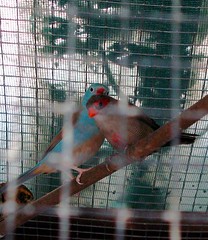


The food was catered by Quentin's, the subject of an earlier post. Except for the dessert which was baked by the ladies of the house - rich, dense fruit cake and rose-flavoured love cake - a particularly sweet memory of Christmases past. Love cake is a Sri Lankan/Ceylonese dish, which is pretty appropriate as the patriarch of this household was a house-proud Ceylonese burgher. Here is a link to a love cake recipe (note, not the love cake recipe) for those who want to know the ingredients. But knowing the recipe is by no means the same as knowing how to bake the cake (and the good news is that the family takes orders!).
Monday, December 25, 2006
The Night Before Christmas
Every Christmas Eve, my mother’s family gets together for dinner. It’s a tradition which we have had ever since I can remember. Christmas is a big thing for Eurasian families. The Christmas tree and Christmas decorations are put up. Christmas goodies (sugee cake, pineapple tarts, shortbread, fruit cake!) are baked or bought. Christmas presents are carefully selected, wrapped and placed under the tree.
My mother reminisces fondly of Christmases past. Those were the days when Christmas Eve was (for Catholics) a day of fast and abstinence. But, my grandmother would prepare Mulligatawny Soup (a hot, peppery and curry-like soup) and boil the Christmas ham all day, filling the house with delicious fragrances, thus making the fast/abstinence all the more difficult (particularly for my grandmother, who cooked the food without even tasting it!). In the days without refrigerators, the ham came cured and packed in sacking. So it was necessary to boil the ham to remove some of the salt.
My grandparents would take their children for Midnight Mass every year. Everyone dressed in their best for church then and obviously for Christmas, a special effort was made. Men came in tuxedos and women in their beautiful frocks and hats. After mass, my grandparents and their family would go home and consume the soup, ham together with a crusty loaf of French bread and a glass of wine. And, my grandfather would start pouring out liquers. For children, he would prepare a special version of Creme de Menthe, a peppermint liquer which he would then dilute with water (I remember him giving me little wineglasses of this too). They would hold open house (yes, this is in the wee hours of Christmas morning!) and everyone would have a good time, chatting, talking and eating.
These days, things are a little different. There is no fast and abstinence (praise the Lord!) and so we have our Christmas Eve dinner at regular dinner hours. And, the variety of food on offer is really quite extensive. This year, we had roast turkey and lamb in addition to the ham and soup (unfortunately, I'd put in too much coconut milk - see below - but it tasted absolute scrumptious anyway). Plus vegetables, lasagna, pasta, rice (saffron and tomato) and gigantic salads. There was fruit, chocolates and cake for dessert and wine to drink. We take out our songsheets and start caroling (not too untunefully, and quite enthusiastically). Then, the kids (defined as anyone who is not earning money) get their presents and they typically put up a little performance for our benefit. Sometimes some family members do go for midnight mass - but we certainly don’t stay up till all hours of the morning thereafter!
Our Christmas tree, too, is a little different from previous years. We have stopped putting Christmas lights or tinsel on our tree. The reason? My dear little cat thinks that the tree and the little baubles, angels and santa elves hanging from its branches are there specially for her benefit and amusement. She also does not think that our arrangements of the tree ornaments are done well and takes the opportunity to rearrange them, frequently taking them off the tree altogether. The result - we have had no choice but to adopt a minimalist style of tree decor.
Here's a recipe for mulligatawny soup below. My grandmother and mother both swear by Mrs Ellice Handy's book, "My Favourite Recipes" and this recipe is modified from her original recipe.
Mulligatawny Soup
based on Ellice Handy's My Favourite Recipes, 2nd Edition. Printed by Malaysia Printers Ltd, 1967.
ingredients
6 pieces chicken breasts - steamed and shredded
My mother reminisces fondly of Christmases past. Those were the days when Christmas Eve was (for Catholics) a day of fast and abstinence. But, my grandmother would prepare Mulligatawny Soup (a hot, peppery and curry-like soup) and boil the Christmas ham all day, filling the house with delicious fragrances, thus making the fast/abstinence all the more difficult (particularly for my grandmother, who cooked the food without even tasting it!). In the days without refrigerators, the ham came cured and packed in sacking. So it was necessary to boil the ham to remove some of the salt.
My grandparents would take their children for Midnight Mass every year. Everyone dressed in their best for church then and obviously for Christmas, a special effort was made. Men came in tuxedos and women in their beautiful frocks and hats. After mass, my grandparents and their family would go home and consume the soup, ham together with a crusty loaf of French bread and a glass of wine. And, my grandfather would start pouring out liquers. For children, he would prepare a special version of Creme de Menthe, a peppermint liquer which he would then dilute with water (I remember him giving me little wineglasses of this too). They would hold open house (yes, this is in the wee hours of Christmas morning!) and everyone would have a good time, chatting, talking and eating.
These days, things are a little different.
 There is no fast and abstinence (praise the Lord!) and so we have our Christmas Eve dinner at regular dinner hours. And, the variety of food on offer is really quite extensive. This year, we had roast turkey and lamb in addition to the ham and soup (unfortunately, I'd put in too much coconut milk - see below - but it tasted absolute scrumptious anyway). Plus vegetables, lasagna, pasta, rice (saffron and tomato) and gigantic salads. There was fruit, chocolates and cake for dessert and wine to drink. We take out our songsheets and start caroling (not too untunefully, and quite enthusiastically). Then, the kids (defined as anyone who is not earning money) get their presents and they typically put up a little performance for our benefit. Sometimes some family members do go for midnight mass - but we certainly don’t stay up till all hours of the morning thereafter!
Our Christmas tree, too, is a little different from previous years. We have stopped putting Christmas lights or tinsel on our tree. The reason? My dear little cat thinks that the tree and the little baubles, angels and santa elves hanging from its branches are there specially for her benefit and amusement. She also does not think that our arrangements of the tree ornaments are done well and takes the opportunity to rearrange them, frequently taking them off the tree altogether. The result - we have had no choice but to adopt a minimalist style of tree decor.
Here's a recipe for mulligatawny soup below. My grandmother and mother both swear by Mrs Ellice Handy's book, "My Favourite Recipes" and this recipe is modified from her original recipe.
Mulligatawny Soup
based on Ellice Handy's My Favourite Recipes, 2nd Edition. Printed by Malaysia Printers Ltd, 1967.
ingredients
6 pieces chicken breasts - steamed and shredded
2 cubes chicken stock
3 tablespoons coriander seeds
(tablespoons refers to big serving spoons here)
1 tablespoon fennel seeds
1 tablespoon cumin seeds
1 tablespoon of peppercorns (but really to taste - put less if you prefer)
6 dried chillis (again, to taste)
1 small piece cinnamon
2 cloves
1 tablespoon tumeric powder
(the above to be all pounded together; alternatively just use a blender)
4 cloves garlic (chopped)
1/2 cup shallots (chopped)
1/2 teaspoon of fenugreek (or alba)
1 teaspoon of mustard seeds
2-3 teacups of cocnut milk (from half coconut)
Tamarind juice (use about 2 tablespoons of the tamarind pulp, soaked and drained - but this is to taste)
Salt
Oil for frying
Boiled rice
instructions
3 tablespoons coriander seeds
(tablespoons refers to big serving spoons here)
1 tablespoon fennel seeds
1 tablespoon cumin seeds
1 tablespoon of peppercorns (but really to taste - put less if you prefer)
6 dried chillis (again, to taste)
1 small piece cinnamon
2 cloves
1 tablespoon tumeric powder
(the above to be all pounded together; alternatively just use a blender)
4 cloves garlic (chopped)
1/2 cup shallots (chopped)
1/2 teaspoon of fenugreek (or alba)
1 teaspoon of mustard seeds
2-3 teacups of cocnut milk (from half coconut)
Tamarind juice (use about 2 tablespoons of the tamarind pulp, soaked and drained - but this is to taste)
Salt
Oil for frying
Boiled rice
instructions
- fry the onions and garlic in a deep pan. Thereafter, add the mustard seeds, fenugreek and the pounded ingredients. Fry for a few minutes, until the mustard seeds pop.
- Add the chicken cubes, two cups (about 500ml) of water and salt and simmer for at least half an hour. Intent is to extract the spices and flavours from the spice mix.
- Strain the mixture, and to the gravy add the coconut milk, tamarind juice and taste. Note that the coconut milk should be thin coconut milk. If you are using a packet of coconut cream, dilute it. Add in more tamarind juice if you like the soup a little more sour. It is also good to have on hand some ready pounded spices just in case you feel the flavours don't quite come out. (Obviously this is not something Mrs Handy would recommend but not all of us are such good cooks!).
- When the soup is boiling, add in the shredded chicken. Pour on top of a serving of rice to eat, or eat with French bread.
Toppings
Soup can be topped with fried onions, garlic, and coriander. My grandmother also served it with fresh red chilli pounded with salt. Up to each person to decide how spicy and hot the mulligatawny soup needed to be.


Merry Christmas!
Subscribe to:
Posts (Atom)
LinkWithin
