Showing posts with label food. Show all posts

Tuesday, December 31, 2019

The Peranakans in Phuket Town

The Marriott Beach Scene
Kitchenette and dining area
My friend invited me to join her for a stay in Marriott's Phuket Beach Club, where she is a member.

We had a lovely 2-bedroom apartment, complete with a little kitchenette, dining and living area.  It was a cosy little place, and as there were only the two of us, we had our own rooms and our privacy.

The resort has a private beach, but as it is jellyfish season, no swimming was allowed.  In any case, the waves looked pretty rough to me.  But it was very pleasant to walk down the beach, looking at the horizon where the sea meets the sky. And to sit by the private pool, with the pool boys bringing around water and the occasional snack (like watermelon).

The resort runs shuttles to Phuket Town and Patong, so we visited both places.  Phuket Town is the civic centre in Phuket, where the government buildings are and where the early Chinese migrants settled. I have been to Phuket before, but never to Phuket Town and so this was the first time I actually learnt that Phuket was a major settlement for Chinese migrants to South East Asia.  According to this site, they were drawn by the burgeoning tin industry.  The Peranakan community prospered and apparently about 70% of Phuket's residents have Peranakan roots!   Hence, here in southern Thailand, we saw Peranakan architecture, clothing and food similar to that of Singapore, Malacca and most of all Penang.

Night Market, Phuket Town
But before exploring Phuket Town, we had to have a massage.  We went to Kim's, which has a number of establishments in Phuket Town and I have to admit it was excellent.  And much, much cheaper than the resort spa (of course).  The ambience is not so serene and restful, but the massage itself really released all the tension in my muscles and back.

We then proceeded to the little "Chinatown".  We had come deliberately on Saturday evening so as to be able to go for the Sunday Night Market in Phuket Town.  I could just imagine myself in Malacca - the Peranakan shophouses either side, the food and souvenir stalls and crowds bustling around.  Buskers sang and their music filled the air.  We walked around, taking in the atmosphere and feeling the buzz.
China Inn, Phuket Town

Later on, we had dinner at China Inn - a restaurant in another old shophouse.  The walls were decorated with old photos - I assume of the family who owned the restaurant - with the ladies all dressed in their Baju Panjang and the men in their western suits.

The food was not so much Nonya as Thai though - we had fish cakes, stuffed chicken wings (yummy), fried brinjal and green curry.  We also had a coconut each - the flesh was young and tender, easy to remove, and the coconut water was so refreshing.  We ended up having coconuts at practically every meal thereafter!

The next day we went off to Patong, famous for its beach and its sex show strip.  We spent enough time on the beach to take a few photos and walked straight through the sex show strip.  We were here for other reasons - like shopping and food!  I bought quite a few packets of Thai sauces (there's a wide range) and my friend introduced me to crispy pork skins (truly addictive). 

Fresh fish at 99 Seafood
But the main reason for our visit was to patronise my friend's favourite Thai seafood restaurant (99 Seafood)!  We ordered so much food I'm amazed that we managed to finish as much as we did - tom yum soup, squid, prawns, a veg dish and this wonderful steamed fish which was then gently poached in a lime/lemongrass flavoured stock.  All the food was very fresh and well cooked - I can see why she comes back here every year.

All too soon, it was time to go home.  I'll always look back fondly on this short, leisurely visit filled with days snoozing by the pool, walking on the beach and eating yummy Thai food.  And of course, discovering yet another little outpost of the Peranakans.

Little Nonya Mural, Phuket Town


More photos here!

Sunday, January 06, 2019

Sugee cake variations

I know, I know - my blog last year was more like a Malaysian holiday blog than a Katong blog!  It just so happened I visited Malaysia more than normal last year.  But let me try and make amends this year with this post on my variations on sugee cake.

Almond-topped sugee
Now I have been making sugee cake for quite a few years now and it has been getting a wee bit tedious.  So I have been trying to tweak the recipe here and there to make it more interesting and also to see how I can enhance the original recipe.  One easy tweak was to top it with almond flakes because my family find the marzipan and icing way too sweet, and to add almond flavouring so that we don't lose the almond flavour the marzipan brings.  Now however, I'm starting to used coarsely crushed unpeeled almonds instead - gives a toasted almond flavour and the crunch of the nuts adds texture.  I'm thinking of crushing them a tad  more finely and using this to partially replace the ground almonds in the cake, for a more rustic sugee.

I have also tried making it with browned butter - an interesting idea, but whilst doing so certainly enhances the buttery flavour of the cake, the nutty-ness of the browned butter doesn't really come through.  In any case, butter should not overpower the almond flavour.

This year, I decided to try it with lemon.  I mentioned it to my mother who reacted with shock and horror.  Heresy!  Lemon in sugee cake! But there are lots of "lemon almond" or "lemon semolina" or even "lemon almond semolina" cake recipes around, for those who want to avoid eating gluten.  So why not?

In deference to my mother's feelings, however, I decided not to drop the traditional sugee entirely. 
Lemon sugee cakes (made in muffin cases)
Instead, I set aside a little batter for two lemon semolina mini-cakes.  I didn't add any almond or vanilla essence in this batch, but added maybe two tablespoons of lemon juice and a little zest.  It was hard to calibrate the amount required for the small amount of batter, so whilst I could taste the lemony flavour, it could have been a lot stronger.  But the bonus was that the cake really had a nice rise, so it is  lighter than the traditional sugee.  I suppose this was the citric acid reacting with the baking powder.

How was it received? My mother basically said that if I wanted lemon cake, to stick to Nigella's lemon drizzle cake recipe which doesn't require me to soak semolina in butter overnight.  Likely she's right but I'm nonetheless glad to have tried this little experiment.

Saturday, June 23, 2018

Big Food Night in Ipoh

We spent one night in Ipoh, just before going back to Singapore.  Of course it was a big foodie night, where we had a huge dinner followed by supper.

For dinner we went to Restaurant Mun Choong (or Mun Zhong) at 57-65, Jalan Horley, Kampung Jawa.  It's also apparently known as Pusing Public Restaurant (or under this group).  It's one of the most popular Chinese restaurants in Ipoh, as attested on various websites including this one here.

Indeed, it was very busy on the Monday night we were there, so we were grateful that we had gone early.  We ordered a sumptious meal, befitting our last night on the road:

Shark's Fin (evil I know but just this once) - really flavourful

Roast Suckling Pig (pork fat is good fat!)

Qing Long (青龙) Vegetables (unusual, we hadn't tried it before)

Fried Prawns - big and fresh!  

Red Bean Soup - with that hint of orange zest

We also had some noodles to complement the dishes.  All in all, a truly excellent meal.  Indeed, Malaysia has so many good Chinese restaurants to visit!

For supper of course it was taugay chicken accompanied by oh-so-smooth-and-slippery hor fan!  There are many famous spots for Taugay Chicken in Ipoh but we went to Onn Kee.  As we were slurping down the hor fan and chomping away on the crunchy sprouts, one of my friends (a native Perak boy) suddenly exclaimed that one of the opposition candidates was walking towards us!  (Don't forget that this was during GE2018 in Malaysia).  Well, he greeted the candidate as though they were good friends, and introduced the rest of us as his friends.  We on our part nodded politely and the candidate walked on, probably guessing (correctly) that our lukewarm reception was because we were tourists.

Supper at Onn Kee

(After eating at Onn Kee, go over to Lam Fong Biscuit Shop around the corner, for traditional Malaysian Teochew biscuits.  I found the ark-am or duck's neck biscuit which I bought in Penang last year.  I really like the texture of the crunchy peanuts against the soft paste of the biscuit.  )

P.S.  For those interested, we stayed at another of those hip new hotels in Ipoh - M Roof Hotel  Residences.  Recommended. The hotel coffeeshop is run by Old Town, which means you get a great coffee for breakfast.  We went back to Singapore the next am, with stops at Bidoh and Seremban for our second breakfast and lunch respectively.

Saturday, May 12, 2018

Teochew Food in Malacca - Teo Soon Loong

When you have a group of two, it's harder to have a good variety of food when eating at Chinese restaurants.  So with our group of four, it was a good time to go try out the food at Teo Soon Loong, a well-known Teochew restaurant in Malacca.  It used to be in a tiny coffee shop on Jalan Hang Kasturi, just round the corner from Jalan Hang Jebat, but has shifted out of the Old Town to a newer, much larger restaurant in a newer part of the city (on the reclaimed land area).

Our hotel got us a car via Grab - a modest RM6 only.  We drove well out of the old town, through undeveloped plots to a small cluster of buildings.  I was not really expecting a large crowd but when we got there, the restaurant was packed!  Good thing that we had a reservation (via our kaki in the jewellery shop).  We had to wait for our table to be ready (we were a little early) and so had ample time to review the menu.

We chose a mixture of recommended dishes (off the internet) - the pork ribs with bittergourd (really tender, highly recommend), the braised Teochew duck (it was good but not as good as the pork), cai por hor fun (good wok hei but not enough cai por for me), braised noodles with oysters (I know, two carbs but we couldn't resist) and sweet potato leaves cooked with ginger (to be honest this was a revelation - I really enjoyed the freshness of the vegetables and somehow the gingery flavour complemented it well).  Indeed a suitable dinner for our last night in Malaccca.


Saturday, February 24, 2018

Sinpopo at Joo Chiat Road


In Singapore's highly competitive restaurant scene, it is quite difficult to write about food because somehow they get outdated quite fast!

Fortunately, unlike some other establishments I've written about, Sinpopo is still going strong.  Although, it looks as though they expanded the menu since I went...

Sinpopo is run by the folks behind Awfully Chocolate but this is completely different in concept, serving "old style" Singaporean food with a twist.  I came here with two lady friends and we had a good gossip, over luncheon meat crisps (terribly unhealthy), deep fried wantons  (scarcely less so), the crab meat bee hoon (my fave) and for dessert, gula melaka cake and brown butter sugee cake.  Washed down with Katong Jelly drink (red agar agar jelly in a 7-Up and soda mix).

Whilst I did feel that the gula melaka cake really brought out that gula melaka flavour, I was not sure that the brown butter flavour was really that prominent in the sugee cake.  Rather, the brown butter flavour was more obvious in the thin layer of butter cream icing the cake.  I was intrigued however by the whole idea of "updating" sugee cake using brown butter and so I was inspired to make my own version of brown butter sugee cake!

First of all, I had to learn how to brown butter.  Fortunately there's a pretty good guide here on Serious Eats.  Briefly, butter is melted and then boiled over the stove till the water evaporates.  As the melted butter continues to boil, tiny little particles of milk solids emerge and as these brown, they impart a nutty, caramel flavour to the butter.  However, you need to watch it carefully to make sure that the little flecks of milk solids don't burn!

My Brown Butter Sugee Cake
Having browned the butter, I then went on to make my sugee cake, which I've written about here.  I soaked my semolina in the browned butter and then made my sugee cake as per normal.  As usual, I did not put any icing or butter cream on the cake which enabled me to taste the "natural" flavours of the cake.

The verdict?  The colour of my sugee cake was a little darker than in the past - not so much a bright sunny yellow but a slightly browner shade.  As for flavour - well, I enjoyed the buttery flavour of the cake, but again the brown butter flavour did't really emerge.  I suspect that with the traditional marzipan and royal icing, the buttery flavour would be overpowered by the strong almond flavour.  It's probably better to take it to a different flavour profile altogether, add brown sugar in place of some of the white, and top with buttercream made with browned butter.. hmmm, seems to be what Sinpopo has done :-)

Thursday, August 31, 2017

Mum's Nyonya Cuisine, Penang

For a Peranakan haven like Penang, it can be surprisingly difficult to get good Peranakan food.  As my uncle said, "home food is best".
So Penang Peranakan families don't go out that much and it is not so easy to find a good Peranakan restaurant in Penang!  Last year, we visited this interesting restaurant near our hotel, in Nordin Street with its unique home environment, genial host and personal demonstration by his mother.  This time round, we were fortunate to have a good, authentic nyonya meal at Mum's Nyonya Cuisine which my relatives took us to.

This is my third food post out of the three posts on this Penang trip, and actually I could go on since I've not really completely covered my hawker food experience (aside from the "Balik Pulau" laksa mention). But then, I've a few earlier posts on this subject from previous visits too, and it is getting a little bit same-same.  I have however put up the shots on my Penang album on Flickr - so if you are interested, do hop over to take a look for what I ate at Jelutong Market, Kimberly Street and the eternal favourite,  New Lane Coffee Shop.

But since I haven't that many restaurant reviews, I'm pleased to devote this post all to Mum's Nyonya Restaurant.  Many Singaporeans are confused by Penang nyonya food because it has marked differences from the Singapore-Malacca brand of Peranakan cuisine.  For example, the use of "assam" flavours rather than "lemak" flavours (its a question of degree; of course Penang food has coconut as well just less so) and the more extensive variety of herbs used.  The influences are Thai, rather than Indonesian (so buah keluak lovers, I am afraid that your favourite dish is not so common here), although some all time favourites like beef rendang find their way everywhere!

Anyway, this is a good place to enjoy the Penang specialities, such as the acar fish (see the recipe here) which is a deep fried fish in a vinegary sauce (which pickles it, hence the name "acar"), and Ju Hu Cha (Cuttlefish strips fried with turnip/carrot/mushroom and rolled in a lettuce leaf) etc.  I also was introduced to a new dish, ikan purut or a fish belly dish cooked with lots of herbs and vegetables.  It is a Penang specialty, which is rather fiddly to cook so it is not surprising that many restaurants don't serve it.  ( See a recipe for ikan purut here.)  These are indeed unique dishes which are not really served in the Singapore Nonya restaurants here, so please do give them a try when in Penang.  After all, what's the point of going to Penang and then trying to look for all the Singapore-style dishes!
Ju Hu Cha

Achar Fish


Ikan Purut

But every dish was yummy and I truly enjoyed the meal.  The slight let down was dessert - not much choice and quite unmemorable (I don't remember what I had and didn't take a photo, which just goes to show how unmemorable I found it).

Better than the food was the company.  The Singapore delegation and our Penang relatives filled two large tables of the little restaurant.  One of my Penang uncles told us little stories about our family during the meal.  How our distant relative, who had been expelled from Indonesia during Confrontation and went back to China, managed to find his way to Penang and to our family home in Malay Street.  Although it had been so many years since his last visit, he remembered the name of the street in Hokkien (apparently, it is called "Thai Gu Hang") and once there, he recognised the house.  He waited outside for some time till my uncle returned and finally he was able to reunite with this branch of the family.  Since then, my Penang relatives hosted a family reunion in Penang and also visited their family members in China.  Because some used to live in Indonesia, they speak some Bahasa and still retain their Hokkien (in addition to Mandarin).  So they are able to communicate with my relatives (who don't speak Mandarin, only English, Bahasa and Hokkien!)  According to my uncle, they remember his great-grandfather (my great-grandfather) very fondly due to the assistance he had rendered them in their times of need.

After dinner, we went back to the family house.  My sister and brother-in-law had never visited before so for them, it was indeed a special experience.  My uncle showed us the improvements he had made since his last visit (he is a self-taught home restorer) and it is indeed impressive to see the progress he makes each time we visit.  Indeed it is the chance to reconnect with our Penang relatives which make each visit back so special.


Saturday, August 05, 2017

Not such a slow durian season

As was the case last year, our visit to Penang was timed to coincide with what we hoped would be the peak of the durian season.  Unfortunately, as related my previous post, the lack of rainfall had caused a late and small durian harvest. This had prevented us from feasting on Orh Chi or "Black Thorn" durians when we visited Nibong Tebal.  Does this mean however that we were totally deprived of durians?  The answer, fortunately, is no.

It was a slow start.  We found a roadside stall on our way back from Nibong Tebal which sold "kampong" durian and a small selection of other durian varieties, which we brought back to my uncle's place for a light snack. The "kampong" durian is really from one of those wild roadside durian trees which people then pick up to sell.   They were not the creamiest nor richest in flavour.  But nonetheless we dug in enthusiastically and within minutes the durians were all gone amongst our large group.

We also had the chance to savour other yummy goodies as well, including the fermented rice snack called tapeh.  It's not easy to get in Singapore (unless you go to the Katong Antique House on East Coast Road which sometimes sells this on a Sunday morning) and is also not that common in Malaysia these days.  But of course my relatives know where to find it in Penang.  I have to say it is an acquired taste, but since my Father has been buying it off and on for years, we have somehow acquired it.  (My sister remembers him feeding it to her as a little girl!).

I also did not mention earlier that the other motivation behind our trip to Balik Pulau was of course to eat durians!  The hills behind the town apparently provide a conducive environment and geography for durians - the right amount of sunshine, drainage, etc.  Here, we could forget all about the late and small harvest.  The durian trees grow in the wild on either side of the road, as it wound through the hills.  My aunts kept telling me that there were durians all around but obviously you need to develop an eye since I only saw the very obvious ones where they were clearly visible against the sky behind.

The durian plantations on the hill typically have their own little stalls on the roadside where customers can sit and eat.  This is what we did last year.  This year, we ended up in the Bao Shang Wang durian plantation stall because my uncle's cousin's Friend owns it. We drove down this really steep road to get to the sheltered terrace where we would eat our durians.  Wow!  It was the first time I've ever eaten durians with such a gorgeous view in front of me!

View from Bao Sheng
Khun Po durian
What was truly very different, however, was the clientele.   Here, in the hills on the other side of Penang, a long car journey from the nearest town, was a bunch of skinny, tanned, Ang Moh Lang dressed like hippies!  Helping sort and clean durians, eating the durians, helping clear away the durian skins and seeds!   Apparently the Bao Sheng durian folk also do some homestay and somehow these chaps found out about it and come to stay.  It was a strange, somewhat surreal experience as I would never have expected to see so many non-Asians so far away from the main tourist spots and eating durians to boot!  It certainly bust the stereotype of the Ang Moh who can't abide the sight nor smell of durian.

Besides human beings, there were a number of dogs wandering around the place.  One or two were the "house dogs"; collared, sleek, plump. Others were strays; skinny, dirty.  Somehow they seemed fairly tame too.

So what did we eat?  We ate (in order of ascending sweetness) : D604; Xiao Hong (a rather orangey colour rather than red); and Khun Po (named after the gentleman who first cultivated it).  The folks who didn't eat durian (yes there were some in our party) were given watermelon and bananas.  We washed down everything with tea.

More durian sampling
And that was not all.  Apparently my uncle's cousin went somewhat overboard and arranged for us to visit a second plantation.  Ummm.... instead we got him to deliver the durians back to my uncle's place and he took them to our family home in Georgetown.  Where we ate them the next day!  Washed down with Chinese tea, to cleanse and refresh the palate, to better savour the next different durian variety.  Alongside, for the non-durian eaters were chiku, pomelo, and other tropical fruits.  Plus another unusual Penang kueh-kueh called "Ee yah kueh".   

So small harvest aside, we still managed to have a most satisfying durian holiday.

Sunday, July 23, 2017

The Other Side of Penang

Early this month, my extended family went back again to Penang for our annual visit.  This year, we had our largest group yet - my Dad, my uncle and two aunties, and five of us from the next generation (including two spouses)!  We met up with my Dad's Penang cousins, and went for our normal, extended foodie experience.

The family house
This year, however, we did things a little differently.  i.e., not just the Penang hawker food binge.  For the first time, we went to "the mainland".  For the uninitiated, the State of Penang is not just one island (Pulau Pinang) but extends also to a small region on the mainland, historically known as "Province Wellesley" in the days of the British and now called Seberang Perai.

It turned out to be quite an interesting drive.  We took the new second link to the mainland - an impressive causeway which is much longer than the first link, and with much less traffic too.  It's always nice to get a feel of the place, driving through the country and seeing what there is to see - not just the normal palm oil plantations but also factories, reminding me that Penang is one of Malaysia's manufacturing hubs.

We had a clear mission for our visit to the mainland.  First, to see if we could visit the family home of my great grandmother (father's mother's mother) in the little town of Nibong Tebal.  At the same time, to eat durians - the elusive "Orh Chih" or "Black Thorn", which apparently was first grown in Nibong Tebal and where therefore the best of this variety is found.  Lastly, we were going to eat yummy seafood in one of the well known seafood restaurants in the area.

Well, at least we managed one out of three!  This year's durian season is a little late.  There was not enough rain and so the harvest is also small.  So there was no "Black Thorn" available.  As for the family home, it turns out that it is hidden behind a row of shophouses.  Access is through a gap in the shophouses but it has now been blocked by one of those shuttered grilles across the entrance.  As we had not called ahead or attempted to contact the residents earlier, we could only peek at it from between the grilles.  Fortunately, the house looked quite well preserved (at least from the outside).

So we were left with lunch.  Fortunately this did not let us down.  Law Cheang Kee is well known for its excellent seafood and as we were early (due to the lack of durian and lack of access to the house), had no problem getting a table.  The restaurant filled up whilst we were there and people were waiting.  This is really a small town so the patrons must have driven from the surrounding areas to get here on their lunch hour.  Our pomfret was beautifully fresh, steamed to perfection and the other seafood dishes were really tasty and flavourful.  Everything was well cooked and I have to say that it was worth the lengthy drive.

Removing the peanut skins
Neither did we walk away empty-handed.  Nibong Tebal is well known, it appears, for its traditional Teochew biscuit shop Chop Chuan Guan, where biscuits are still made by hand every day.     It is like a factory, with a row of biscuit makers sitting in a row in the main shop.  In the shop next door, a girl was removing the peanut skins from the roasted peanuts.  It was quite fascinating, watching her skilfully and efficiently toss the peanuts on a large flat basket, till the skins separated from the peanuts.

The shop is famous for its unique and rare "duck neck" biscuit, or "ark-am"!  This biscuit has a crunchy peanut core, with a soft outer layer, and covered with a layer of peanuts.  It is rolled up into a thin roll and cut into long pieces, hence the name.  Certainly, no ducks were harmed in the making of this biscuit :-)  It is really quite yummy so I can understand the brisk business - visitors were coming in whilst we were looking around it, just to get a package of their favourite tau sar piah or ark-am.   Which is what I did, too.  I should have bought another packet!  Ah well, hopefully there will be a next time.

The next day, we went to Balik Pulau.  Balik Pulau literally means "back of the island" or "go back to the island".  It's literally on the opposite side of the island from Georgetown and there's a totally different, laid back atmosphere here.  But things are changing, as new developments are encroaching on this little town.  There's even an international school, the "Prince of Wales Island International School" which boards students whose families are presumably working in the region.

"Laksa cham"
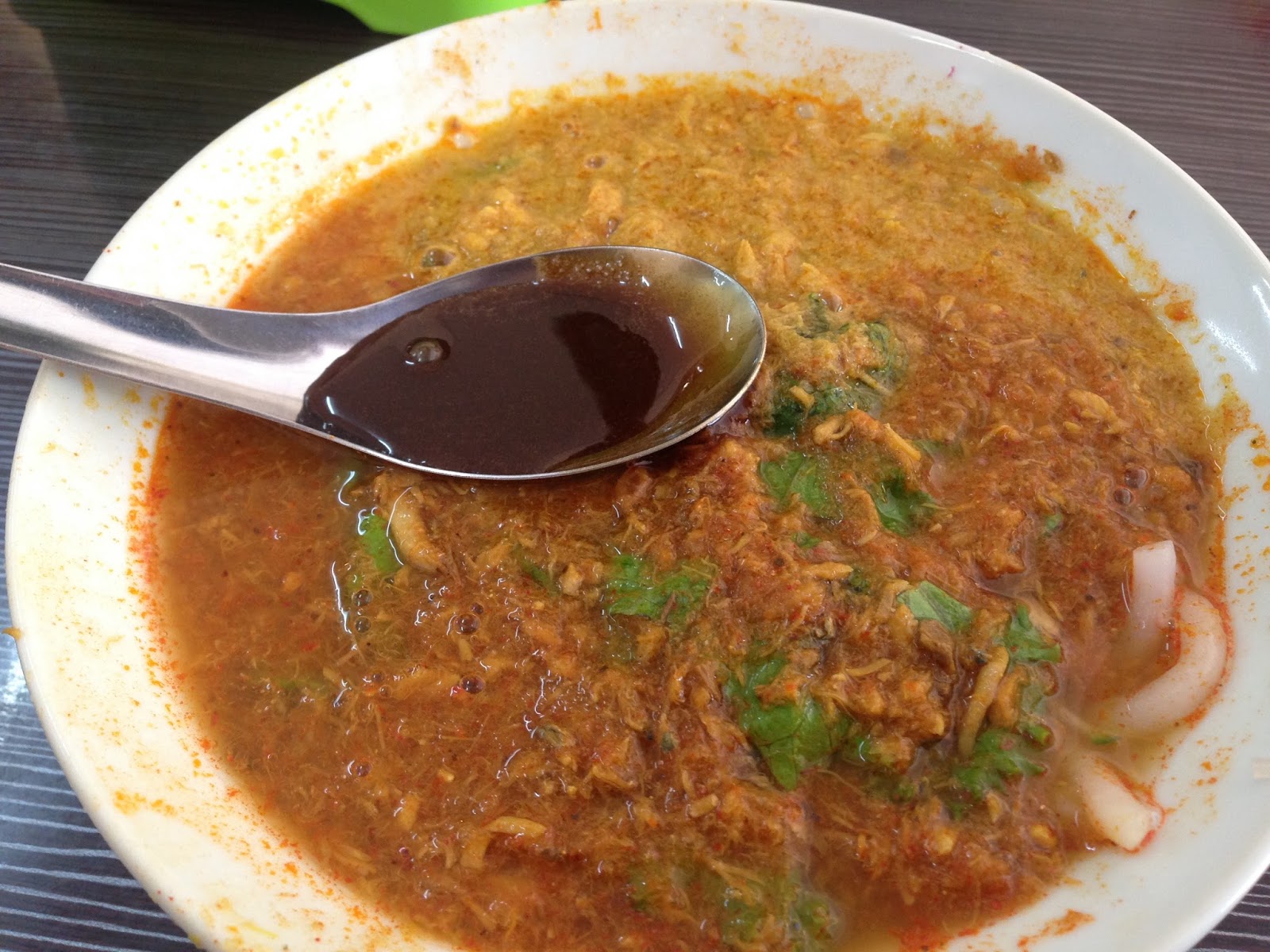
We came here to eat the famed Balik Pulau laksa at Kim Seng Kopitiam.  But I have to admit that I did not eat the traditional laksa.  Instead, I had Penang Assam Laksa mixed with the lemak curry laksa (which we get in Singapore).  Here, they call it "laksa cham" and you can ask for it in stalls which sell both laksa varieties.  I really like the way the lemak gravy is livened up by the tangy assam gravy.

I was expecting to eat in one of those small street stalls but it was in a rather modern coffee shop.  We went for another bowl at a nearby hawker centre, where we also drank ampala and ate pasembur (the Indian rojak of Penang).  It was similar to our Singapore hawker centres.  Not so "balik" after all!

Overall, I enjoyed our visits to Nibong Tebal and Balik Pulau.  It took us to a very different side of Penang, outside Georgetown and away from the beaches where the tourists congregate.  A sense of what Singapore used to be like, and indeed what the bigger cities in Malaysia used to be like.  Hopefully, even as Penang continues to grow and develop, these little towns will continue to retain some of their charm and unique little gems like Law Cheang Kee and Chop Chuan Guan.  Looking forward to going back to Nibong Tebal for more food treats and of course, to see my great-grandmother's home in all its glory...

More photos (including food shots) on my Penang album on Flickr.

Saturday, February 18, 2017

Pot of Patchree


I have had a busy few months, going on my year-end holiday, then preparing first for Christmas followed by Chinese New Year.  Then the start of the work year meant less time for my various pastimes, including updating this blog.  Well, time to make up for the quiet few months!

I decided this year to make Patchree for our extended family Christmas meal and followed that up with the traditional curry devil on New Year's Day.

Brinjal Patchree
Patchree (also spelt patchri), it seems, is not a well known dish.  In fact I could not find many references to it online.  Fascinatingly, however, I found one, of all unlikely sources, in the archives of the Washington Post, embedded in a 1984 article about the chef from the Singapore Embassy in Washington DC!  So I am truly adding something new to the universe of information found online by adding this simple recipe here!

Anyway, patchree is a Eurasian vegetable dish, probably Portuguese in origin given its hot and sour curry base, and the complex mixture of spices which go into the dish.  It's traditionally made with pineapple or brinjals, but I suspect the pineapple one is more popular, albeit called by the more common name of "pineapple curry".  Variations on how to prepare the dish exist - one recipe from "Robin's Eurasian Recipes" fries the brinjals, and then ladles the sauce on top.   Others cook the brinjals in the gravy.  This year, since I love lots of gravy, especially with loads of chili, I decided to go with Mrs Handy's recipe, which cookes the brinjal in a tamarind-based gravy.  I was glad I did - my Grandmother used to refer to Mrs Handy quite a bit and so the flavours of this dish brought back memories of her cooking.  And I think my family members felt the same way, for the dish was mostly finished with only three small pieces left at the end of the meal.

Devil Curry
One of my aunts brought a pot of devil curry for dinner, which sort of whet my appetite for more.  So, I whipped up another pot for our New Year's Day meal.  I basically used the same devil curry recipe which I have already included in this blog, but added potatoes and tomatoes into the mix.  And since we had some rather nice expensive bratwurst (or whatever "wurst") I put that in too, rather than the tiny little cocktail sausages.

Just the memory of the dish makes my mouth water.  Which is why I've added in the photo into this post as well.

Anyway, here's the brinjal patchree recipe from Mrs Ellie Handy's "My Favourite Recipes" (I added in the English names of the spices, and quantities of the spices in powdered form):

Ingredients

4 tablespooons oil
10 shallots, finely sliced
6 cloves garlic, chopped
1 cm fresh ginger, chopped

Curry Paste
1 dessertspoon Ketumbar (2 teaspoons coriander powder)
1 dessertspoon jintan puteh (2 teaspoons cumin powder)
1/2 dessertspoon jintan manis (1 teaspoon fennel powder)
Piece of turmeric, size of two peas (1/2 teaspoon turmeric powder)
8 dried chilies, soaked

2 cups thick tamarind juice from 1.5 dessertspoon tamarind
2 tablespoons sugar, or to taste (I used 4!)
Salt to taste
4 brinjals
3 green and 3 red chillies, split halfway up
2 sprigs curry leaves, optional (for garnish).

Directions

1. Cut the brinjals lengthwise into half, and then cut each piece into two.  Make two diagonal slits in the flesh of each piece and soak in water for about half an hour.

2. Make the curry paste, by blending the spices and chillies together (of course you can pound it all together if you wish).  May need to add a little oil to the mixture if you are using all powders. 

3.  Fry the onions, garlic and ginger in the oil till soft.  Add the curry paste and fry till fragrant.  Then add the tamarind juice, salt and sugar to taste.  Then add the brinjals and chillies.  Cover the wok (I always use a wok) and leave to cook.  Garnish with the curry leaves.

That's it!  Simple but yummy.  If you're interested, more recipes by Mrs Handy here. 

Sunday, September 25, 2016

The Long Table


The "Tok Panjang" is a Hokkien/Malay "portmanteau word" which means "long table", or a table liberally covered with lots of yummy dishes where the family serves itself, buffet style, on special occasions such as Chinese New Year or birthdays, etc.

It's also the name of a new restaurant on East Coast Road, which ironically serves a limited menu meant for individuals/ small groups having a quick meal.   Dishes like mee siam, Penang laksa, Nonya Lam Mee, etc.  There are a few mains such as babi pongteh, rendang, and sambal prawns, which can be purchased a la carte or as a set (which comes with rice and a serving of chap chye and itek tim).  It has also a selection of appetisers for sharing, such as kueh pie tee, ngor hiang, etc.

In general, the food is tasty and good as one would expect of restaurants under the House of Peranakan group.  I enjoyed the mee siam, which was sharp and tangy, and the Penang Laksa tastes like the real thing.  Even my father (who compares every bowl of Penang laksa to his grandmother's family recipe) said it was "quite good".  On another occasion we shared a babi pongteh set and sambal prawns amongst two people and it was probably just right for two light eaters.

Prices are reasonable too - though obviously a little more expensive than hawker centres.  But I did find the appetisers a little on the expensive side, as portions are small.

In the highly competitive restaurant scene, it's really a struggle for all these small restaurants to survive and thrive.  All I can do is publicise my favourites as best I can on this blog.

So here's wishing Tok Panjang well!

Saturday, January 30, 2016

Old Bibik's Restaurant

It is a precarious business, reviewing restaurants.  The Singapore F&B scene is a highly competitive one and I have to admit that many of the restaurants covered in this blog have since closed.

But I do think that when I come across a nice restaurant, it is good to share the news.  It is in that spirit that I now embark upon this review of "Old Bibik's Restaurant".

Old Bibik's was formerly in the Lavender Street food market before the market was closed, and has now relocated to the MDIS building at 190 Changi Road  Famed for its rendang, the restaurant offers a range of nonya dishes and there's a handy list of one-dish meals which are good for take-aways.

We went there for lunch one Sunday afternoon - ate their famous rendang which indeed was tender and flavourful.  I really enjoyed the fried chicken wings - well fried, savoury.  Their "soy chendol" dessert, made up of a tau huay pudding-style base with the red beans and little green chendol "worms" on top, is also light and refreshing.    

Since then we have been back a few times and have always come away satisfied.  So, do give it a try.


Friday, November 13, 2015

Peranakan Arts Festival 2015

I was intending to make a trip down to Malacca this year end but for various reasons (largely scheduling) it did not work out.  But in the end, I didn't mind too much because I got to go to the Peranakan Arts Festival instead!

Programme booklet - inside cover
The Peranakan Arts Festival was held from 4-8 Nov 2015 and comprised numerous components:
- The Ba-bazaar!  One of my fave events, not just the stalls but the accompanying talks, cooking demonstrations, etc.
- The Baba-Nonya Convention 2015
- Two plays, Pintu Pagar and Bibiks behind Bars, Kena Again
- An art exhibition
- A Tok Panjang wedding dinner to round off the event

Typically, there is an annual Convention and Ba-bazaar but I believe that this year, the intent was to broaden the event into a full-blown festival, celebrating the Baba-Nonya culture.  Thus the inclusion of the plays and the art exhibition too.  

My friend and I picked up tickets for "Pintu Pagar" - the Friday matinee.  We had made a pact to dress up in our sarong kebaya and met accordingly at the Ba-bazaar 2 hours before the show started, to wander around the shops and attend the cooking demonstration.  We had thought that there would be tonnes of people there all dressed up in sarong kebaya.... shall we say that maybe they were planning to come dressed for the evening shows or the dinner instead.  And then at last we spotted at a distance one lady making her way to the big tent, dressed up in her kebaya.... ... and lugging some big bags as well.  She was one of the stall holders!  

The shops themselves had a good variety of makan, jewellery, some kitchenware and curios (including a few shops from Malacca as well).  There was also a books stall, with recipe books and heritage related books.  I restrained myself from buying more cookbooks and bought just one book  - 'Being Baba", a compilation of articles from "The Peranakan", the magazine of the Peranakan Association Singapore.

Baba Philip Chia demonstrating his signature laksa

The cooking demonstration was hosted by Baba Philip Chia, who was making his signature laksa for the audience.  Baba Chia explained that he picked up his cooking from his various aunties, each of whom had her own special dish.  He discussed the herbs and rempah which go into the traditional Singapore/Malacca laksa recipe and the audience got to play with the various herbs as well.  Of course, the highlight of the event was sampling his yummy, super-lemak laksa. His other cooking demonstrations include mee siam and peranakan canapes (paired with wine).  His cookbooks were also on sale at the little bookshop.  More about him in this article. 

After the cooking demo, it was time for the play.  The theatre was not full - I guess most people were more attracted by "Bibiks behind Bars".  But "Pintu Pagar" was something a little different.  It was not in the Baba Malay patois but in English, with occasional words here and there (but not many).  It had just four actors, two of whom played dual roles as the parents of the star-crossed lovers who were the focus of the play.  "Pintu Pagar" refers to the half-door entry to a Peranakan home.  The typical home has a full door, which is open during the day and only the half door is closed, providing privacy whilst allowing for some ventilation into the house.  The analogy to our loving duo?  That the two doors swing together side by side, but never meet...

Anyway, our two lovers are star crossed indeed.  Our 14-year old nonya meets her 17-year old (non-baba) neighbour but the families don't get along.  So they marry other people and whilst their paths cross occasionally, they live their lives apart.  I liked the premise of the play, but did feel that it was a little too dramatic for me - arranged marriage to older husband, sickly child, wife with mental condition etc etc.  And of course by the time they get together, it is (almost) too late.  Could it have been equally effective without such drama?  I think so, personally.  I was also not sure whether the dialogue reflected accurately the phrases in use at the times (eg in the 1960s) - sometimes it sounded just too "2000s" to me.  Nonetheless the two leads delivered competent performances.  The star performer, however, was definitely Nora Samosir's performance as the mothers of both our nonya and her beau.  Her elegantly slim kebaya-clad figure (and outrageous hairdo) and nonya "accent" contrasted completely with the simple clothing and gentle tones of the young man's mother.  Her husband(s) too was able to show an effective contrast in performance as he played his dual roles.  

In short, I had a thoroughly enjoyable festival, reconnecting with my nonya self.  Looking forward to putting on my kebaya again for CNY....     

Saturday, December 27, 2014

Festive fruit cake

As is my usual practice, I made my traditional sugee cake this Christmas, plus some mince pies.  Plus my mother made her shortbread.  But I felt that it was time for something new.  So, I decided that this year would be the year I tackled fruit cake! Fruit cake is another Eurasian Christmas classic, a British tradition handed down to the local community in Singapore.  But, I never got round to making it even though my mother continued to get a commercial cake (normally the Lion's Club charity cake) every year.

So I started checking recipes.  I looked through Mrs Ellice Handy's book for her recipe, but was totally bowled over by the amount of fruit (almost 2kg worth) and the fact that the recipe was for 3 medium loaf tins!  Of course, I could have just divided the recipe by 3 and baked just a single loaf.  But considering that this was my first attempt, I decided to play it very safe, and use Nigella Lawson's traditional fruit cake recipe from her "Domestic Goddess" cookbook.  Nigella has generally been pretty reliable, at least for the recipes I've used.  And this particular recipe gives the different quantities for different fruit cake sizes.

And indeed, I think it turned out quite well, as the photo indicates.  There was still masses of fruit in the recipe, but I thought that the end result was quite moist, full of sherry-soaked raisins and mixed fruit.  It smelt wonderful too!

I can't seem to find the original recipe online, but Nigella has provided a slightly modified version here. The main difference, as she says, is that she upped the alcohol content and replaced some of the fruit with chopped pecans.  I can live with that :-)  On my part, I normally cut the sugar content by about one-third since I'm not too keen on sweet cakes. The original recipe also called for marmalade, rather than treacle, a substitution I'll probably stick to as I don't really use treacle for other dishes and we are huge fans of breakfast marmalade in this house. 

So maybe this is a cake to come back to again in future years.  The other good thing with fruit cake, of course, is that it has to be made in advance, so it doesn't really add to the hustle and bustle of Christmas.   

One small thing to end with.  For the first time ever, I heard about a "sugee fruit cake" which one of my colleague makes.  Coincidentally, my aunt received one from a Malaysian friend and we ate it at my cousin's Christmas dinner. I must say it is a denser, heavier cake than our traditional fruit cake.  But it interested me, this fusion between the two Christmas classics.  So I looked it up on line and it seems indeed to be quite common in Malaysia, but the origins seem to go back to that island in the Indian Ocean , where other semolina-based cakes have come from.  Here's the recipe I spotted, for anyone who'd like to give it a try and then report how it turns out so I can figure out if I want to do it too!

And of course - Merry Christmas, everyone!

Friday, March 21, 2014

First, let's eat!


Grilled charcoal fish
The House of Sundanese Food started off in a little shophouse near the Holy Family Church in Katong.  It subsequently moved (to Suntec City) but now it is back again!  But in a different guise, because they wanted to broaden their menu to include other non-Indonesian items.  Bring it on, I say.  Especially when this means they have pohpiah on the menu!

Tauhu Telor
House of Sundanese's new restaurant, "Makan Dulu" is now at Katong Shopping Centre - a corner shop, facing the road.  We have our favourite dishes - the charcoal grilled dishes such as fish (see photo) and chicken, rather tasty and succulent beef rendang, and a lovely ayam bumbu (fragrant curry with a very more-ish curry gravy).  Indonesian favourites such as tauhu telor (below) and sayur lodeh are also available.

"Makan Dulu" translates directly to "Eat First" in Malay.  It is used in many ways, for example, someone who is coming home late might say "makan dulu", or in this context, don't wait for me, eat first.  Or it may be used by a mother to a child who wants to go off and play - you have to eat before playing.  But in this context, it truly reflects the priority we Southeast Asians place on food :-)

For more details, their Facebook page is here.

Monday, December 30, 2013

What the Devil


Ellice Handy's Curry Devil
Devil Curry (also called Curry Debal, Curry Devil, etc) is one of those classic Eurasian dishes, for which every household has their own special recipe and their own traditions surrounding when they cook/prepare it.  But, one key characteristic of this dish is that it is cooked with leftover meats.  So, most households will make it after Christmas Day - a good way to use up all that leftover turkey!  I must admit that in my household, we don't cook this particular dish.  We normally don't have turkey on Christmas Day in the first place.  It's roast lamb and cold ham for us.  That's why I often end making gammon curry instead.  And for some reason, we just don't make it other times of the year.  

This year, however, my uncle turned up on Christmas Day with a lovely roast turkey, complete with all the accompaniments of stuffing, gravy, cranberry sauce and even a lovely little cranberry and apple relish.  Of course, we could not finish the turkey.  I turned to my recipe books for a good Curry Devil. I read through the lengthy lists of ingredients (including roast pork, potatoes, cucumber and even cabbage).  But my mother had only one recipe in mind - Ellice Handy's recipe out of her 'My Favourite Recipes" cookbook.  That was the version her mother used and if was good enough for her mother, it was good enough for us.  No potatoes, no cucumber, no cabbage.  No roast pork even (my mother wouldn't have minded, but we didn't have any in the house).  It was just the leftover roast turkey meat and some sausages.  

This is a nice, simple recipe to cook.  And since the meat is all cooked up, it's pretty fast too.  I doubled the quantities in Ellice Handy's recipe since I was using far more than 1/2 pound of meat.  Also some slight variations here and there. It's one wicked dish!

Here we go:

Ingredients:

4 slices of ginger, cut into short strips
2 large onions, sliced
Leftover meats (I used about a quarter of a turkey, plus 3 sausages, sliced)
(1 tablespoon of brown mustard seeds, optional)
3 tablespoons of tomato paste (or use 2 large tomatoes, sliced)
2 teaspoons of mustard (Coleman's)
4 tablespoons vinegar
1 tablespoon sugar

Spice paste
12 shallots, peeled
2 cloves of garlic
10 dried chillis, soaked in warm water till soft and cut up (add more chillis for extra wickedness!)
4 fresh chillis 
1 teaspoon of tumeric powder
1 teaspoon of belacan, toasted
3-4 buah keras (candlenuts)

Directions:
1.  Prepare the spice paste, pounding ingredients together (or use a food processor like me). 
2. Fry the ginger and large onions in a large pan till soft.  Add in the mustard seeds (cover the pan until they have popped).
3.  Add the spice paste, fry till fragrant.  Add the leftover meat and sausages.
4.  Add the remaining ingredients.  Continue to cook, adding a little water (keep it a dry curry though) for some gravy.  Ready when the gravy thickens a little.

Saturday, September 14, 2013

Pineapple and Apple Crumble

Or, what to do with leftover pineapple jam when you get tired of making pineapple tarts.

I was inspired to make this rather delicious crumble by a visit to Cafe Brio at the Grand Copthorne Hotel.  Their buffet lunch happened that day to serve a pineapple and banana crumble.  As I didn't have bananas handy, I decided to try it with apples instead.

It is a very easy crumble to make.  Peel and cut apples into segments, then layer it with the pineapple jam in the baking tray.  Top with the crumble.  Bake.  Serve with homemade vanilla ice cream..

Smooth, velvety ice cream contrasts with the deep rich caramel-ly pineapple jam and the crunch of the crumble.  A perfect pairing.

Saturday, April 27, 2013

Under the Big Tree: Notes from Ipoh

As anyone from Ipoh will tell you, the "Big Tree" in Ipoh is not just any big tree... it is a well known hawker joint!  I just made my first trip to Ipoh, to visit my uncle and cousin, together with two other family members. As usual, my family members indulge in eating and shopping on holiday. So although there is nothing about Peranakan or Eurasian culture in this post, I thought I'd put it up as a sort of companion post to my earlier, gluttonous, (in)famous celebration of food in Penang.

Braised fish head
We reached Ipoh on the Friday afternoon, and after checking into our hotel (Ipoh Downtown - clean, reasonably priced and very well located) we were off! After a short shopping excursion, we went for dinner at "Best Restaurant" on Jalan Yang Kalsom. The food was well-cooked, with the standouts being the soft tauhu with fish paste on top, and the braised fish head (chopped in pieces, battered, and beautifully fried, then served with tauhu, vegetables and a savoury gravy). A good meal indeed.


But today was the day when we did our worst. The tally for me :

Breakfast:
- Curry mee, with smooth, translucent thick bee hoon noodles.
- Chee Cheong fan (CCF), with pork and mushrooms. A light gravy, sprinkled over with sesame seeds and fried shallots.

We then crossed the road, only to find Canning Gardens CCF there. Of course, we had to eat it. The sauce is much thicker and sweeter, but the noodles are also soft and went down as smooth as silk.

Lunch 
Dim Sum selection
Ming Court Dim Sum is supposed to be one of the best dim sums in Ipoh. Somehow, all the restaurants of the same type congregate in the same place. Dim Sum restaurants together, Tauge Chicken together, etc etc. Fortunately for us, our hotel was on the street just parallel to the dim sum restaurants (walking around the corner in the other direction, we would hit the tauge chicken restaurants).

I really enjoyed the yummy dim sum, with nice yu mai (sort of a steamed fishball), fried fishballs (no nasty factory fishballs here); dumplings with pork and peanut filling; mua chee with a soft, gooey exterior complemented with sweet-salty peanut filling within. Also a soft and fluffy cha siu pao and a smooth black sesame cream dessert.

I'm surprised that after all this we still had room for Funny Mountain tau huey (or toufu fa) for a second dessert!

Post-lunch snack
YTF at Big Tree
Yong Tau Foo under the Big Tree. Despite our extremely substantial lunch, we went here because we had heard of the famous Big Tree and wanted to at least see the place.  Big Tree itself was crowded, with lots of people either having a late lunch (or their own after-lunch snack).  We went to the next door "New Big Tree" for the YTF (a branch of the original which is in the original Big Tree) - cleaner, newer, shorter queue for YTF.  A place I'd want to go back to again, given the opportunity, because I was so full after the precious rounds that I had only space for a few pieces of YTF and a sweet sour lemon lime drink.

Tea
Apparently people from all over Malaysia, Singapore and even Hongkong come for JJ Swiss Rolls.  These rolls come in many flavours, big ones, and mini ones  We had a half of chempadak and half of durian.  I liked the fruity filling, and the roll itself was nice, but somehow maybe we should have tried the minis with their interesting flavours of spinach, pumpkin, and so on.

Dinner
Ipoh Tauge - shorter, fatter, crunchier
Tauge chicken at Lou Wong. The chicken is probably the same as what you get in Singapore. The tauge on the other hand was definitely different- Ipoh tauge is shorter, fatter, crispier than its Singapore cousin.  And it was blanched just right so that it remained crunchy. The hor fan in the very tasty chicken stock soup was also very good - thin, transluscent and smooth.

It's probably best for my weight that we're leaving at 7.30am tomorrow.

With thanks to family members on this eating binge, it's great to be able to share food with you!  Especial thanks to aunt and cousin, who helped come up with the title to this post.

Afternote:  

A Happy Send-off
Obviously, we managed to get in one last breakfast (Ipoh Central Cafe opens before 6.30am, which is when we got there!). Another plateful of CCF to share, and a yummy breakfast of wan tan mee, with 5 small, perfect little wan tans in transluscent wan tan wrappers.

We also had a good lunch of KFC at the airport.  Juicy chicken, fried just right.  Somehow even KFC is better in M'sia!

LinkWithin

Related Posts Plugin for WordPress, Blogger...