Showing posts with label Penang restaurant reviews. Show all posts

Monday, December 31, 2018

Penang Peranakan food

I was chatting to my colleague just before our holiday to Penang and she kindly shared with me a few restaurants which she had been patronising on her own frequent visits to Penang.

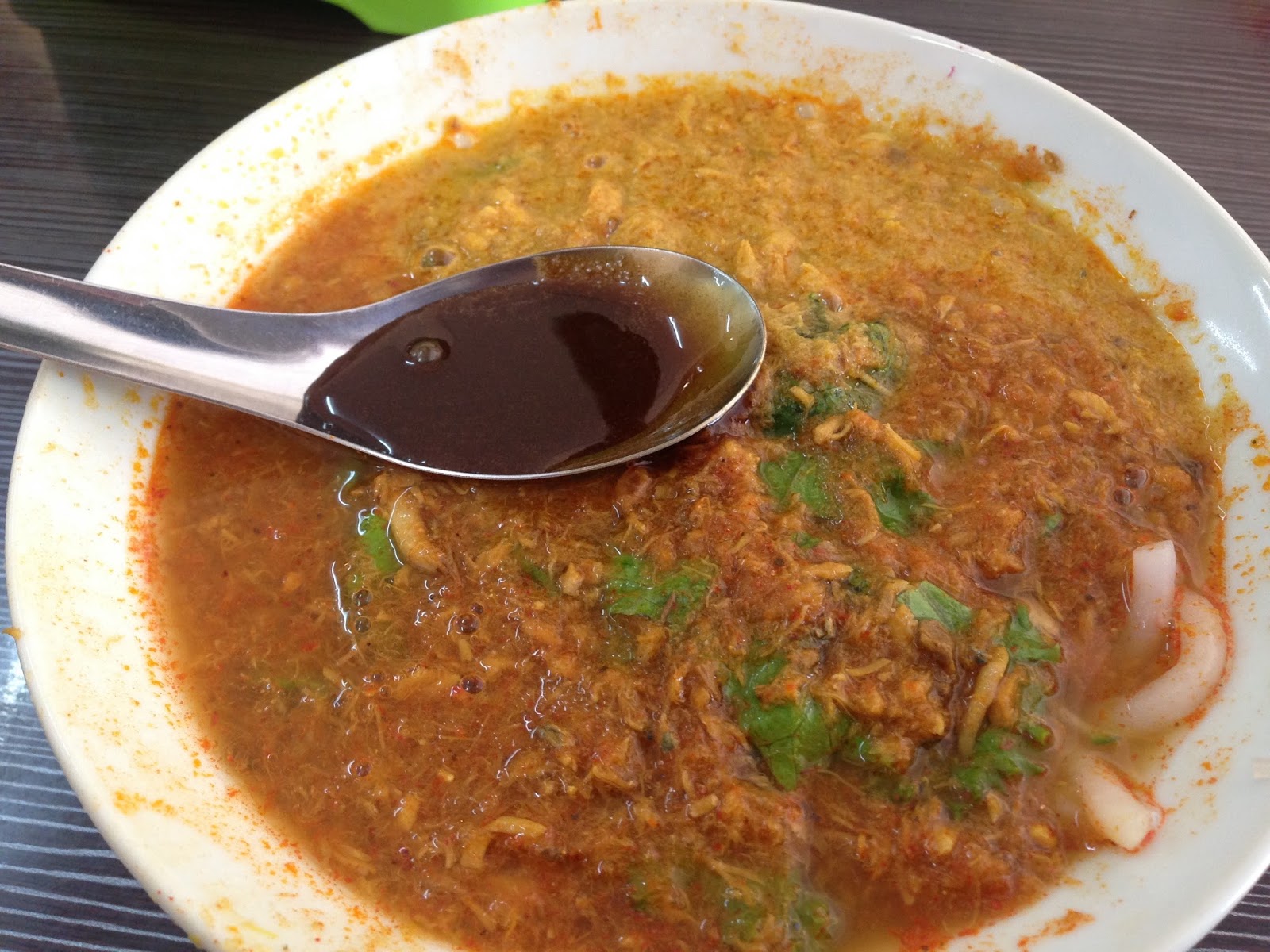
Prawn Noodles at Malay Street
As a result, we ended up going to quite a few restaurants this visit to Penang!  Of course there is that seafood one which I wrote about in my last post.  But because of this, we ended up going to fewer hawker stalls (except for the Malay Street coffee shop which we went to THREE times to eat the famous Tiger Char Kway Teow and our favourite lor bak and prawn noodles, washed down with "ampala" juice - also known as "umbra" or "kedongdong").  I have to admit I have also stopped writing up on my Penang hawker experiences - it was getting a little repetitive but maybe next trip we will have to make an effort to revisit all the old favourites.

Food - from left to right: jiu hu char, inche kabin chicken,
assam fish head, rendang, hee peow soup, acar/otak/hae bee
Anyway, we are trying to work our way through the nonya restaurants in Penang and our first visit this trip was to Ivy’s Kitchen on Jalan Chow Thye.  This is a small family restaurant - Ivy’s the cook and her husband runs the front of house.  The restaurant is not that big so it might be good to make a reservation.

The food was excellent - we had the assam fish head, the jiu hu char (bangkwang or jicama fried with cuttlefish, and wrapped up in a lettuce leaf before eating); a beautiful creamy otak-otak, fried inche kabin chicken, achar, rendang (nice and tender) and hee peow (fish maw) soup. 

My favourites were definitely the otak - this was incredibly creamy and delicate, and the assam fish head - the gravy was so tasty and the dish was sprinkled liberally with bunga kantan (torch ginger). But everything was really very tasty and the portions were  generous (sized for our group of eight).  In summary, this is was authentic and yummy nonya food at reasonable prices.  We're coming back here.

Food (clockwise, from top right): Laksa,
Too-thor thng, assam fish, jiu hu char,
babi pongteh, fried mixed veg.
The next restaurant we went to was quite different - Richard Rivalee's, in M Mall.  Richard Rivalee is a well-known fashion designer in Penang but he learnt how to cook his grandmother's nonya recipes.  He started off with a small cafe beside his boutique but has now expanded to a larger restaurant in M Mall.  I didn't have time to visit the mall but from what I understand it is targeted at tourists and as such the shops mainly sell branded goods so I don't think I missed much! The restaurant itself is really very charmingly decorated, with lots of little Peranakan touches about the place such as the tiles on the walls, the kebaya clad mannequins and the Chinese couplets on either side of the doors. 

Food-wise, I have to say that the rempah/ gravy for all the dishes were really tasty and authentic.  But I was not too happy that a number of dishes were not available, for example the otak-otak, and the ikan purut (fish stomach), which I had been looking forward to!  Also, when I ordered the fish dishes, they were the same selar fish whether it was achar fish or assam fish (what I ended up ordering after finding out that the otak and ikan purut were both not available). 

Besides the two fish dishes, we had jiu hu char (again), babi pongteh (rather nice), and too-thor thng (peppery pig stomach soup).  We also had a rather interesting mixed vegetable dish - with four angle beans, petai beans, fried together with onions, sambal and prawns.

But what I really enjoyed was the assam laksa!  The gravy was rich yet piquant, and the helping was pretty generous too.  It's not quite a "pure" assam laksa as I think they added coconut milk, which would make this "laksa cham" or a cross between assam and lemak laksa.  Mmmm.... I could come back for this next year, too. 

Can't wait!

If you want to look at all my Penang food reviews, they are here.

Friday, December 28, 2018

Fresh Seafood in Tambun, Seberang Perai

Prawn Village, Tambun
My family has started making little trips to the Penang mainland on our annual trips and this year we decided to go to a seafood restaurant in Tambun.  Tambun is a little fishing village with just one major road running through it, and not much more.  But because it is on the river (Sungei Jawi), it gets a lot of seafood and therefore, seafood restaurants.

My Penang Uncle recommended Prawn Village, Tambun, and since he is the local we followed his advice.

The restaurant is not much to see from the roadside (see photo on the right).  But upon entering the restaurant, we were greeted by a wide expanse of water - the river runs just behind.  We were happy to have a table just by the river.

The river behind
Mantis prawns
True to its reputation, the restaurant wall is lined with tanks of water on the way in, each with its own inhabitants.  I didn’t go and examine them closely (I don’t want to know my dinner that well) but if you want to see some photos of the live seafood you can check them out here.

We ordered a range of dishes - prawns, fish (cooked steamboat style in a hot pot), mantis  prawns, clams, crab and the like.

I rather like the mantis prawns, which I have never noticed on menus in Singapore.  It’s not really a prawn per se, being more like a mini lobster/shellfish.  It gets its name from its larger pincers which apparently resemble those of the praying mantis insect.  As they are fast, and the pincers are sharp, these little shrimp are considered lethal predators, spearing or smashing their pray with the pincers before gobbling them up.

I had eaten it before on our previous trip to Nibong Tebal, cooked in sambal.  This time round, they were lightly battered and fried.  I would liken the texture of the meat to being a little more like crayfish than prawn, tender and delicate, quite contrary to its "lethal predator" image.   Just glad I didn’t have to deal with the big pincers!

Of course I also had masses of their delectable crab cooked with sambal chili but not smothered in sauce (which is Singapore style).  They gave us huge wooden mallets to crack open the shell.  Photos of the crab, and of some of the other dishes are below:

Chili crab

Clams in Chili and garlic

Lovely fresh fish, steamed Teochew style

Prawns with garlic

Stuffed Yu Tiao and Tau Hu

And the price?  I can tell you, that for a group as big as ours, the price can only be considered extremely reasonable, especially by Singapore standards.  Not gourmet cooking but well-cooked, tasty, super-fresh seafood dinner.

We went back to our hotel, full and happy 

Thursday, August 31, 2017

Mum's Nyonya Cuisine, Penang

For a Peranakan haven like Penang, it can be surprisingly difficult to get good Peranakan food.  As my uncle said, "home food is best".
So Penang Peranakan families don't go out that much and it is not so easy to find a good Peranakan restaurant in Penang!  Last year, we visited this interesting restaurant near our hotel, in Nordin Street with its unique home environment, genial host and personal demonstration by his mother.  This time round, we were fortunate to have a good, authentic nyonya meal at Mum's Nyonya Cuisine which my relatives took us to.

This is my third food post out of the three posts on this Penang trip, and actually I could go on since I've not really completely covered my hawker food experience (aside from the "Balik Pulau" laksa mention). But then, I've a few earlier posts on this subject from previous visits too, and it is getting a little bit same-same.  I have however put up the shots on my Penang album on Flickr - so if you are interested, do hop over to take a look for what I ate at Jelutong Market, Kimberly Street and the eternal favourite,  New Lane Coffee Shop.

But since I haven't that many restaurant reviews, I'm pleased to devote this post all to Mum's Nyonya Restaurant.  Many Singaporeans are confused by Penang nyonya food because it has marked differences from the Singapore-Malacca brand of Peranakan cuisine.  For example, the use of "assam" flavours rather than "lemak" flavours (its a question of degree; of course Penang food has coconut as well just less so) and the more extensive variety of herbs used.  The influences are Thai, rather than Indonesian (so buah keluak lovers, I am afraid that your favourite dish is not so common here), although some all time favourites like beef rendang find their way everywhere!

Anyway, this is a good place to enjoy the Penang specialities, such as the acar fish (see the recipe here) which is a deep fried fish in a vinegary sauce (which pickles it, hence the name "acar"), and Ju Hu Cha (Cuttlefish strips fried with turnip/carrot/mushroom and rolled in a lettuce leaf) etc.  I also was introduced to a new dish, ikan purut or a fish belly dish cooked with lots of herbs and vegetables.  It is a Penang specialty, which is rather fiddly to cook so it is not surprising that many restaurants don't serve it.  ( See a recipe for ikan purut here.)  These are indeed unique dishes which are not really served in the Singapore Nonya restaurants here, so please do give them a try when in Penang.  After all, what's the point of going to Penang and then trying to look for all the Singapore-style dishes!
Ju Hu Cha

Achar Fish


Ikan Purut

But every dish was yummy and I truly enjoyed the meal.  The slight let down was dessert - not much choice and quite unmemorable (I don't remember what I had and didn't take a photo, which just goes to show how unmemorable I found it).

Better than the food was the company.  The Singapore delegation and our Penang relatives filled two large tables of the little restaurant.  One of my Penang uncles told us little stories about our family during the meal.  How our distant relative, who had been expelled from Indonesia during Confrontation and went back to China, managed to find his way to Penang and to our family home in Malay Street.  Although it had been so many years since his last visit, he remembered the name of the street in Hokkien (apparently, it is called "Thai Gu Hang") and once there, he recognised the house.  He waited outside for some time till my uncle returned and finally he was able to reunite with this branch of the family.  Since then, my Penang relatives hosted a family reunion in Penang and also visited their family members in China.  Because some used to live in Indonesia, they speak some Bahasa and still retain their Hokkien (in addition to Mandarin).  So they are able to communicate with my relatives (who don't speak Mandarin, only English, Bahasa and Hokkien!)  According to my uncle, they remember his great-grandfather (my great-grandfather) very fondly due to the assistance he had rendered them in their times of need.

After dinner, we went back to the family house.  My sister and brother-in-law had never visited before so for them, it was indeed a special experience.  My uncle showed us the improvements he had made since his last visit (he is a self-taught home restorer) and it is indeed impressive to see the progress he makes each time we visit.  Indeed it is the chance to reconnect with our Penang relatives which make each visit back so special.


Sunday, July 23, 2017

The Other Side of Penang

Early this month, my extended family went back again to Penang for our annual visit.  This year, we had our largest group yet - my Dad, my uncle and two aunties, and five of us from the next generation (including two spouses)!  We met up with my Dad's Penang cousins, and went for our normal, extended foodie experience.

The family house
This year, however, we did things a little differently.  i.e., not just the Penang hawker food binge.  For the first time, we went to "the mainland".  For the uninitiated, the State of Penang is not just one island (Pulau Pinang) but extends also to a small region on the mainland, historically known as "Province Wellesley" in the days of the British and now called Seberang Perai.

It turned out to be quite an interesting drive.  We took the new second link to the mainland - an impressive causeway which is much longer than the first link, and with much less traffic too.  It's always nice to get a feel of the place, driving through the country and seeing what there is to see - not just the normal palm oil plantations but also factories, reminding me that Penang is one of Malaysia's manufacturing hubs.

We had a clear mission for our visit to the mainland.  First, to see if we could visit the family home of my great grandmother (father's mother's mother) in the little town of Nibong Tebal.  At the same time, to eat durians - the elusive "Orh Chih" or "Black Thorn", which apparently was first grown in Nibong Tebal and where therefore the best of this variety is found.  Lastly, we were going to eat yummy seafood in one of the well known seafood restaurants in the area.

Well, at least we managed one out of three!  This year's durian season is a little late.  There was not enough rain and so the harvest is also small.  So there was no "Black Thorn" available.  As for the family home, it turns out that it is hidden behind a row of shophouses.  Access is through a gap in the shophouses but it has now been blocked by one of those shuttered grilles across the entrance.  As we had not called ahead or attempted to contact the residents earlier, we could only peek at it from between the grilles.  Fortunately, the house looked quite well preserved (at least from the outside).

So we were left with lunch.  Fortunately this did not let us down.  Law Cheang Kee is well known for its excellent seafood and as we were early (due to the lack of durian and lack of access to the house), had no problem getting a table.  The restaurant filled up whilst we were there and people were waiting.  This is really a small town so the patrons must have driven from the surrounding areas to get here on their lunch hour.  Our pomfret was beautifully fresh, steamed to perfection and the other seafood dishes were really tasty and flavourful.  Everything was well cooked and I have to say that it was worth the lengthy drive.

Removing the peanut skins
Neither did we walk away empty-handed.  Nibong Tebal is well known, it appears, for its traditional Teochew biscuit shop Chop Chuan Guan, where biscuits are still made by hand every day.     It is like a factory, with a row of biscuit makers sitting in a row in the main shop.  In the shop next door, a girl was removing the peanut skins from the roasted peanuts.  It was quite fascinating, watching her skilfully and efficiently toss the peanuts on a large flat basket, till the skins separated from the peanuts.

The shop is famous for its unique and rare "duck neck" biscuit, or "ark-am"!  This biscuit has a crunchy peanut core, with a soft outer layer, and covered with a layer of peanuts.  It is rolled up into a thin roll and cut into long pieces, hence the name.  Certainly, no ducks were harmed in the making of this biscuit :-)  It is really quite yummy so I can understand the brisk business - visitors were coming in whilst we were looking around it, just to get a package of their favourite tau sar piah or ark-am.   Which is what I did, too.  I should have bought another packet!  Ah well, hopefully there will be a next time.

The next day, we went to Balik Pulau.  Balik Pulau literally means "back of the island" or "go back to the island".  It's literally on the opposite side of the island from Georgetown and there's a totally different, laid back atmosphere here.  But things are changing, as new developments are encroaching on this little town.  There's even an international school, the "Prince of Wales Island International School" which boards students whose families are presumably working in the region.

"Laksa cham"
We came here to eat the famed Balik Pulau laksa at Kim Seng Kopitiam.  But I have to admit that I did not eat the traditional laksa.  Instead, I had Penang Assam Laksa mixed with the lemak curry laksa (which we get in Singapore).  Here, they call it "laksa cham" and you can ask for it in stalls which sell both laksa varieties.  I really like the way the lemak gravy is livened up by the tangy assam gravy.

I was expecting to eat in one of those small street stalls but it was in a rather modern coffee shop.  We went for another bowl at a nearby hawker centre, where we also drank ampala and ate pasembur (the Indian rojak of Penang).  It was similar to our Singapore hawker centres.  Not so "balik" after all!

Overall, I enjoyed our visits to Nibong Tebal and Balik Pulau.  It took us to a very different side of Penang, outside Georgetown and away from the beaches where the tourists congregate.  A sense of what Singapore used to be like, and indeed what the bigger cities in Malaysia used to be like.  Hopefully, even as Penang continues to grow and develop, these little towns will continue to retain some of their charm and unique little gems like Law Cheang Kee and Chop Chuan Guan.  Looking forward to going back to Nibong Tebal for more food treats and of course, to see my great-grandmother's home in all its glory...

More photos (including food shots) on my Penang album on Flickr.

Sunday, August 28, 2016

A Penang Nonya Meal

Little Kitchen@Noordin Street
Surprising as it may seem, I have never had a meal at a good Nonya restaurant in Penang.  One reason is because of our insistence of chasing down every single lead we have on yummy hawker food.  Another reason is that my Penang relatives keep on talking about how "home cooking" beats all the restaurants hollow.  So they don't really have good suggestions for us.  Lastly, there are other good Chinese restaurants in Penang (eg the time I had a simple, tasty Hainanese meal).

So this time round we made special efforts to find a good Nonya restaurant to host dinner for our relatives.  After consultations/online research etc etc we finally found "Little Kitchen@Nyonya" which was located just behind our hotel.  The sheer convenience sold it for us.  

Lucky Bat
Having said that, there are a good number of reviews of the Little Kitchen online, such as this one. Set in a residential area, the restaurant is a family-run business and they run it from their own home.  All the restaurant "staff" are family members, with the host/owner Mr Loh taking the orders, his mother, wife and other family members doing the cooking and serving of the food.

The restaurant is actually the front reception room of the family home.  The family used to run a bird's nest business and there are samples of the nests on the walls and in big jars standing on the tops of the cabinets in the home.  Evidently the business did well, as this is a beautiful home - large, ornately decorated in the Peranakan style.  Cast-iron grilles adorn the windows and doors, and the rooms are decorated with beautiful plaster mouldings and with lucky symbols such as the bat (which represents the five fortunes of good health, wealth, longevity, virtuousness and a peaceful death) on the pillars. The furniture looks mostly antique - from the old carved cabinets, the massive dark wooden chairs, the wood-and-marble day bed, etc etc.  It looks and feels like what it is - a traditional family home.

Family dining table, also used when the diners overflow
restaurant area
An ornate screen separates the restaurant area from the family area. Whilst the restaurant is meant to be confined in the front reception room, on busy nights, it overflows into the family dining area behind.  The kitchen is traditionally located at the back of a peranakan house but in this case, they moved it to the adjacent garage/driveway to be nearer to the dining area.  Not many households would have had a car in those days, so you can tell that this was indeed a well-off family!

There is a set dinner of about 8 dishes (a soup, vegetables, chicken, prawns, fish, curry, meat, rice) for RM128 per person.  There's a 5 dish set as well, and a more expensive set but this is the one we chose.  Food is traditional Penang nonya, cooked by the women of the family.  According to the owner, Mr Loh, they decided to start up the restaurant because his mother was lonely and bored after her Husband died and she had no one to cook for.  She's now in her eighties and still going strong!

Mrs Loh senior preparing Nasi Ulam
The food also comes with free flow of drinks - nutmeg (hot and cold), longan tea and green tea.  Prepared in advance, you can help yourself from the large thermos flasks on the sideboard.  There's kueh kueh to start off with, and dessert to end up with.  After our kueh kueh, dinner proper started off a traditional nasi ulam, the mixture of rice and finely chopped herbs and dried prawns which I've written about in an earlier post.  This is indeed the highlight of the meal, where Mrs Loh senior slices and dices the herbs finely whilst we watch and admire her knife skills.  Mr Loh explains the dish and presents the herbs which are used in the dish.  He even gives a little quiz and hands out a prize to my aunt, who gave the right answer.  Together, they give a polished performance.  Mr Loh admits that his mother still won't let him wield the knife as she says his knife skills just aren't good enough.  Light, fresh and tasty, the nasi ulam doesn't last long as we eat it with gusto.

The other dishes come quick and fast - pig's trotted soup, chincalok pork, prawn and pineapple curry, my favourite four-angled beans and lady's fingers with sambal, kari kapitan (chicken curry),  and the tangy achar fish.  We finished off with pulot hitam, the black glutinous rice porridge served with coconut milk.  The food won't win any prizes for presentation ("plating" is certainly not a concept known in the Peranakan kitchen), but for good, hearty traditional home-cooked nyonya food - this is a winner.  


More photos on Flickr.

Saturday, October 20, 2012

Penang Food Trails - Five Years on

My extended family decided to make a group visit to Penang - to meet up with relatives there, and of course to fill up on gorgeous hawker food!  Since the last time I went down was some five years ago, thought it was high time for me to join in.  Indeed, there have been changes in Penang since my last visit.  New shopping malls (First Avenue), nice new pavements down Penang Road, that sort of thing.  But thankfully, the variety and quality of the street food is as memorable as ever.

The good thing about meeting up with Penang natives is that they always know where the best food is and can take you there. I had a really good time during my last visit to Penang but most of the eateries were near or off Penang Road, with one trip down to Guerney Drive (see my previous post).  This time round, we really were able to explore more parts of the island...  Read on for the yummy details:

1.  New Lane coffee shop, off MacAlister Street

Batu Maung Satay
- no peanut sauce required
Our first stop, after we got out of the hotel.  We had a real feast, with traditional favourites like Penang Kway Teow, Poh Piah, Dumpling soup etc. And more familiar dishes, but with a twist only seen in Penang - like Batu Maung Satay (the meat has been really steeped in a tangy marinade and beautifully grillled so that it retains the moisture  and flavour inside) and Char Kuay Kak (Chai Tow Kuay with prawns and squid).  I also had a nourishing bowlful  of itek mee sua - duck meat in a herbal soup and mee sua.  For the first time, I also had a ambola or kedongdong drink with a little sim boay floating in it.  The sharp sour flavour really complemented the savoury food well. 

2. Lorong Kucing coffee shop

Sinful goodness - Roti Babi
My cousin, after her last family trip to Penang, came back raving about the Roti Babi here.  For the uninitiated, Roti Babi is indeed a mouthful of sinful (cholesterol and fat-laden) goodness.  But heck, it's once every few years!  Take two thick pieces of bread, stuff the minced pork filling in between, cover in breadcrumbs and deep fry.  Since we had about 10 people, we ordered something like 5 plates of the roti babi and much more besides, including appom telor, curry mee, more char kway teow and poh piah, wan tan mee etc etc.  We probably over-ordered and over-ate.  But again, who is counting the calories! 

3. Batu Lancang Hawker Centre

Pasembur
We made another stop at Batu Lancang Hawker centre, near my aunties' home.  Here, the dish to try is the pasembur,  an Indian rojak prepared Chinese-style.  Confusing?  It's just Asian fusion food.  Crispy crackers, potatoes, fritters, tau kwa and cucumber, topped with a sauce made of sweet potato and strips of cuttle fish. This large hawker centre is also apparently where another cousin's favourite Penang Kway Teow is (he eats three plates at one sitting).  And yes, I did have a plateful of this tasty dish.  Whilst it's not durian season, we also bought a few trays' worth from the nearby market.

4. Malay Street Coffee Shop 

Mee Sua Kor
This coffee shop, at the corner of Malay Street and Carnavaron Road has a whole range of yummy goodies. For the first time, I tried mee sua kor, mee sua in a thick gravy with strips of crab meat and other meats.  I'd never heard of it before but I really hope to be able to find its like in Singapore.  It was here also that I had my first serving of prawn mee soup on this trip - somehow, a good prawn mee is harder to find than the ubiquitous Penang Kway Teow.  Lots of Oommph.  My Penang uncle said that there was a better prawn mee down the street.  But I really was not complaining.  We slurped it down in double-quick time. Another great dish to try here is the Ngor Hiang/Lor Bak - succulent, flavourful meats.

5.  Penang Road (again)

Keng Pin's Ngor Hiang 
Well, back to Penang Road.  Old favourites such as the Penang Laksa and chendol at Lebuh Keng Kwee, and the Ngor Hiang and prawn fritters (my personal fave) at Keng Pin coffee shop up the street were still there.  My family savoured a pig organ soup in Ho Ping coffee shop too.  It's not for nothing that our hotel was on this street!

What was my total food tally?  Bear in mind that this list covers only what I personally ate/sampled (over the course of about three days), and figures in brackets refer to the stalls I went to:

Penang Kway teow (4)
Roti Babi (1)
Pasembur(1)
Itek with mee sua (1)
Chendol (2)
Durian (1)
Pohpiah(2)
Lor bak/ngor hiang(3)
Appom(1)
Yam/split green bean fritters (1); 
Dumpling soup (1)
Kuen kosui (1)
Mee Sua Kor (1)
Satay - Normal (1)
Satay - Batu Maung (1)
Offal Soup (1)
Porridge (offal) (1)
Zi char veggies (1)
Assam laksa (1) 
Prawn Mee (1)
Char Kuay Kak (1)
Smoked Chicken Waffle (1)
Nasi lemak (1) - at airport!

Will put up more photos on Flickr page when ready.  In the meantime, drool away...

(Update: Photos up here!)   

Saturday, October 13, 2007

Penang Food Trails

Now, it may appear a little odd that I am posting entries on Penang in this blog about Katong. But to me there are many linkages. Penang is about family, food and Straits Chinese heritage, which is really what I associate Katong with too. Of course here in Katong the Eurasian factor comes in as well. Anyway, that is why these posts about Penang are on this blog.

Assam laksa, Penang Kway Teow, Chendol, Lor Bak! We visited Penang with a clear and serious intent: to eat our way through as many delectable hawker goodies as possible! Well, we can say that we have visited a number of good stalls but alas, there are so many places we did not manage to get to.

When eating in Penang, it is essential to have a clear goal and strategy in mind:
  • First, work out which stalls you wish to visit and plan your route accordingly.

  • Second, remember it is about sampling. No point stuffing yourself at the first place. Order a small helping, preferrably to share. Don't gorge even if it is good. There will be more good stuff later on too.

  • Third, don't worry about introducing variety. Remember, it is also about comparison purposes. You'll never know if you had the *best* Penang laksa if you haven't tried a few stalls.

  • Fourth, share drinks. The coffeeshops require you to buy a drink from them. So you could get filled up on all that liquid.

  • Fifth, take notes. What will you do if you forget where they are by the next time you get to Penang?
Here is my food tally:

Bee Hooi Coffee Shop at Kimberly Road - Penang Kway Teow, Yong Tau Fu. The YTF was just so that we could have something wet to go with our kway teow. We did not realise until we checked the old review that we had actually selected a well-known kway teow stall. But I certainly appreciated the large and fresh prawns which accompanied the dish. The kway teow was tasty too, perhaps a tad wetter than the Singapore rendition of Penang Kway Teow. BTW, this photo was taken on my mobile phone rather than my camera. Note the size of that prawn!

Guerney Drive - 2 samples of assam laksa, kueh pie tee, some lok lok, 1 sample of Penang kway teow. The kway teow (although it was also supposed to be famous) was not really up to par. The laksa from the first stall we tried had well-flavoured stock, and I noticed then that the noodles tend to be much softer (cooked for a little longer?) than the al dente version served in Singapore. I thought also that the blend of condiments was just right, with the ginger flower adding just the right twang to the dish. I was however a little surprised with the pie tee as there was no little shrimp on top and the chilli was not fresh chilli but some sauce.

Malay Street (at the corner of Malay and Carnavaron)- The best Lor Bak we had. Juicy, succulent meat in the crispy wrap.

Penang Road - Lor Bak and Prawn Fritters from a famous hawker, cooked with style and panache. Here he is at his wok. Further down the road, at Lebuh Keng Kwee, we ate yet another serving of assam laksa (rank 2 of the 3 samples we had) and truly yummy chendol.

Apparently, the green worms in Chendol are not just made of flour coloured green the way it is done in Singapore. It is made of a special herb which gives the jelly that green colour. The Penang variety of chendol is made with the gula melaka syrup poured over the crushed ice, before the diluted coconut milk, green jelly worms and kidney/red beans are poured on top. This particular hawker was famous! Every time we asked for directions to Lebuh Keng Kwee, we had problems. We asked for "the chendol stall" and everyone knew where it was. We found out upon coming back to Singapore that he has branches across Malaysia, including Johor Bahru.

Lorong Chulia - We also had one meal at a small local Hainanese restaurant, pork chop, itek tim (duck soup with preserved vegetables), lor bak and mixed vegetables. The shop has many regular local clients and the jovial proprietor clearly knew them all. Wearing a neatly tied apron, and with a little hat on his head, he discussed their orders rather than just took them. There is no menu in any case. You have to talk to him or his mother (?) to work out what is available. It was a hearty, homecooked meal.

Penang is where you regret that you have only one stomach. I must admit that I've probably had enough laksa, kway teow to last for a few weeks but very soon I'll be BACK at the penang food stall in Marine Parade...!

LinkWithin

Related Posts Plugin for WordPress, Blogger...