Saturday, July 10, 2010

A Family Wedding


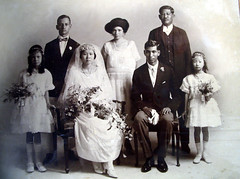
Wedding Photo, 1923
Originally uploaded by Taking5
My grandaunt's wedding, in 1923.  She was my grandfather's older sister.  My grandfather was the best man and is standing in the back row, on the left. The flower girls are their younger sister (on the right) and another young relative.  The older couple were the sponsors of the bride and groom.

Besides this group photo, there would be photos of just the couple. They would send a small copy of the photo to their friends and relatives. My grandaunt and her husband received quite a few of these photos, including one for a certain Mr and Mrs Lee Chin Koon...

It is difficult to find a description of Eurasian weddings of the 1920s.
But a more contemporary record can be found in "Singapore Eurasians- Memories and Hopes" (ed. Myrna Braga-Blake) :

"Weddings were Saturday morning affairs with the Mass followed by a cake and wine reception. Curry puffs, sausage rolls, cream puffs, sambal and ham sandwiches were also served. The wedding cake was specially ordered and it would, at one time, havecome from "Ah Teng" in Victoria Street and later from "Cona's" in Katong - bakeries famous for sugee cake...
According to my mother, the typical way to ask an engaged couple whether they had set a date: "When is your cake and wine?"
"A wedding gift had to be something useful for the couple. Though a couple often ended up with five irons, six toasters and lots of Pyrex dishes, they were all graciously accepted. It was not considered in good taste to give money, though today the more practical accept monetary gifts... ... it was also expected that the bride wrote a personal note of thanks to everyone. Even today, a little thing like a personal handwritten note of thanks is a hallmark of Eurasian etiquette."
Indeed, our cupboard used to hold numerous tea sets which my mother received as wedding gifts.

"The wedding reception was a joyous occasion for speech making, toasting and good-natured teasing... ... The traditional song at weddings was "Jinggelly Nona" - a dance in which all, both old and young, would join in.
The reception ended with the bridal couple leaving amidst the clouds of confetti thrown at them."
My earliest recollection of a Eurasian wedding was my uncle's.  My cousin and I were the two flower girls walking in front of them into the church bearing our little bouquets proudly, just happy to be in all the photos.  I remember the confetti.  I think we helped to distribute it.  These days, most churches/ restaurants don't encourage confetti because of the mess it leaves behind. 

For more on Eurasian weddings, read here.

Friday, June 25, 2010

My Great Grandfather

I was visiting my maternal grandmother one day when I discovered an old photo album on her table.  My uncle (who lives with her) explained that his cousin had come by with her family album - full of old photos of her parents and other family members.  Amongst the photos, was this one of my maternal grandfather's father - my great grandfather - and his second wife.  

According to my grandfather, in his interview by the Oral History department (two sessions in Jan 1980), his father was born somewhere near or in Liverpool. He came to Singapore for better opportunities in 1893 or thereabouts, and worked as a draftsman either in an architectural firm or an engineering firm (Riley Hargreaves).

He subsequently left and ran his own company as an estate agent. My grandfather recalls visiting him in his office at 3A Finlayson Green:

"I had sometimes come down with him from Katong, possibly at the age of 11 or 12, I think, and I was always in his office playing with the Empire typewriter, and getting in the way of the clerks...

... He had a Chief Clerk, another Assistant Clerk, a peon, a man named Wahab...

He was estate agent to 17 London rubber companies and supplied them with -from rice to rubber cups, rubber tapping knives, and what else there is to it, I don't know really."

My great grandfather married a local girl, and had a son, my grandfather (born in 1906).  They adopted another daughter.  My great grandmother died a few years later, and my great grandfather married again.  He had 3 more children - one boy, two girls.  His second son died young.  But my grandfather, his adopted sister and his two half sisters lived to a ripe old age.

Afternote: I googled my great grandfather's name and found that:
He is recorded in the 1881 Census of Britain as living in Liverpool.  Aged 15 years at the time, he was the oldest son in a family of 3 boys and 2 girls.  Hence if he came to Singapore in 1893, he would have been around 27 years.  By the time of my grandfather's birth, he would have been 40 years old. 

I found him also on the list of registered jurors in Singapore, in 1904.  He was listed as working for the Shrager Brothers.  Further checks turned up a 1902 newspaper advertisement in the Straits Times indicating that the Shrager brothers operated a fire-clay and pottery works business.

Amazing, all you can learn about your family without leaving the room!

Sunday, April 18, 2010

Kerabu, or Penang-style nonya salad

It has been some time since I featured a recipe on this blog, and thought it was time to revisit this theme with a post on kerabu. It is always interesting to see how people react when they see kerabu.  Many are not too familiar with Penang Nonya dishes as there are quite a few differences between Penang nonya food and the Malacca/Singapore variety. 

Kerabu is a nonya salad, it is very much influenced by Thai cuisine with its combination of sweet, sour, spicy favours all wrapped up in a good dose of umami.  There are many different types of kerabu - jellyfish, fungus, cucumber/pineapple, tau gay, etc.  For some reason or other, my family favourite seems to be kerabu made of kacang botol (or winged bean, or four-angled bean). More recently I tried making kerabu out of tunghoon (mung bean vermicelli).  Here's a quick recipe for both.

Dressing - Ingredients

The dressing for kerabu is always the same - sambal belacan, or chillis and toasted belacan (a dry shrimp paste) pounded together.  You can either make your own (adjusting for spiciness) or just buy a bottle from a reputable producer.  Roughly, the proportion is:

4-5 red chillis
1 tbsp of toasted belacan

Add salt, sugar and lime juice to taste (for kerabu, since it is a dressing, probably about 4-5 limes minimum).

Variation: If you don't have sambal belacan handy and are too lazy to make it, you can also try slicing up some red chillis and adding some Thai fish sauce to the dressing

Salad base
For kerabu kacang botol, ingredients would include :

Wingbeans/kacang botol (typically about 1 packet for 4 pax) - blanch in boiling water so that they retain that crispy texture, cut thinly (I like it  about half a centimetre), on a slant.
4-5 shallots, thinly sliced
2 tablespoons dried prawn (haebee) -  soaked, pounded
1 tbsp toasted grated coconut (kerisik) - purists would include it, but it is a pain to toast the coconut so I would call it optional.

When the ingredients are ready, toss together in the dressing.

For kerabu tunghoon,  

100g dried tunghoon - soak in warm water and it will expand
300g prawns (shell, devein, cook quickly in boiling water or microwave them)
2 shredded carrots
8-10 shallots, thinly sliced
100g taugay or beansprouts
1/2 cucumber (shredded, pulp removed)
3 stalks lemon grass (thinly sliced)

Toss together in dressing, garnish with mint leaves or coriander leaves. Can also add other things, like the kerisik, as well.

Enjoy!

Note: the kacang botol kerabu is our own home recipe, whilst the tunghoon kerabu is adapted from a recipe for kerabu beehoon found in Nonya flavours: A complete guide to Penang Straits Chinese Cuisine.  Many other yummy kerabu recipes there!

Saturday, April 10, 2010

That Small Town Feeling


Work-in-progress
Originally uploaded by Taking5
One thing which struck me about Malacca was that the folks were friendly, in the sense that they sort of take an interest in you and your activities.

People want to know where you are going for dinner and like making food recommendations. Our hotelier started telling us where we should eat and one day as we were leaving the building for dinner, asked us where we were off to. Certainly in a big hotel you won't get this. It is not busy-bodyness but a genuine interest in what you are doing.  The jeweller we visited also asked the same questions. He recommended a small out-of-the-way restaurant and even offered to make a reservation for us. It was an attractive offer - when you make your reservation (a few hours in advance) you place your order. I liked that as it implies that the food is really genuine, the rempah prepared by hand just for you. But I didn't fancy his advice that we would need to tell the taxi to come back for us. Memories of the last time I was in Malacca came back to me, when we went to the Portuguese settlement for dinner not knowing that it would be half deserted and that we would need to get the restaurant owner to drive us back to our hotel. Which brings me back to my main point, that people in Malacca are friendly and helpful. (We did tip the restaurant owner for the taxi ride though).

We found that the shopkeepers were generally friendly. This picture was taken in a shop off Heeren Street, which was serving as an artist's (Stanley Ho's) studio-cum-gallery. The long low building suited him admirably, with the bright courtyards providing light for his painting.  He invited us to take more photos. 

We also visited two shops which made/sold beaded shoes, or kasut manek. One was just opposite our hotel and was run by a man, his wife and her sister. The two ladies sewed the beaded tops and he was the shoemaker who made the shoes. One sister showed us around the place. Once upon a time, their whole family had lived there. Today, the place is half in ruins, as it is too difficult to keep up and they live in the few rooms nearer the front of the house (which is the shop). But she was happy to tell us about her life there and show us her completed shoe tops. I was wondering about getting a pair made but then, it would be necessary to come back in a month or so to pick up the shoes. But would that be so terrible a thing to do? Hmmm....

Saturday, March 27, 2010

Visiting Malacca

Malacca, Penang and Singapore- the three trading hubs known as the Straits Settlements, and governed collectively as a Crown Colony by the British.  But Malacca's history of colonisation goes back much further.  It was captured by the Portuguese under Afonso de Albuquerque in August 1511.  In 1641 the Dutch defeated the Portuguese to capture Malacca.  Subsequently, the Dutch traded Malacca with the British settlement of Bencoolen in Sumatra. Because of these successive waves of colonisation, Malacca, more so than Singapore or Penang, displays a deeper cultural diversity than either city.

My own family history says that my maternal great-grandmother, was from Malacca before she came down to Singapore and married my great-grandfather.  But my visit to Malacca was prompted more by the wish to have a little break from work and at the same time to do some shopping (hopefully a kebaya or a pair of beaded shoes).  I came back with a pair of antique earrings instead, and a comfortable feeling that my kasut manek creation will indeed stand out in comparison with anything in Malacca. 

Visitors to Malacca can't really miss the "Red Square" - the Dutch Studhuys, Christ Church and other municipal buildings. 

But one highlight of my visit has to be the climb up to St Paul's church.  The church was built by the Portuguese in 1521, surely making it one of the oldest Catholic churches in Southeast Asia.  Originally named "Our Lady of the Hill", the church was renamed by the Dutch when they took over Malacca and converted it to a Dutch Reform church. It was subsequently abandoned and has fallen into ruins over the years.  Walking around the ruins today, and looking at the tombstones around the sides of the church, the sense of history still remains strong.  Some names on the tombstones are familiar, like Westerhout and de Wind, as their descendents are still living in Malaysia and Singapore today.  Tour groups, student groups, individual tourists/families walk quietly around the site. 

In the middle of the chapel is a wired cage, marking the spot where St Francis Xavier was buried (in 1553). the saint's body was disinterred subsequently and transferred to Goa in India (another Portuguese settlement).  I was amused when a Malay family also made a little donation (maybe the little boy simply wanted the fun of putting coins through the donation slot). 

The colonial heritage  is largely in the buildings, the Peranakan influence surely permeates the culture of Malacca.  Busy Jalan Hang Jebat or Jonker Street (I love the convenience of one-street shopping!) contains shop after shop selling kebaya, pineapple tarts (I much prefer Singapore ones), kasut manek and antiques. 

Behind it,  Jalan Tun Tan Cheng Lock or Heeren Street is lined with the residences of the Peranakan families of over a hundred years ago.  These houses had narrow frontages but go back quite a way, with rooms arranged around 2-3 courtyards.  Today, they are in varied condition - some are part ruined, with the costs of maintenance way above the means of the families living there.  Some have been converted for other use - restaurants, or hotels (like our very nice residence).   It may be a little sad that the place is getting commercialised, but frankly since the other alternative seems to be abandoned/ruined buildings, I'm all for it.  But there is one feature which makes it so much more difficult to walk down the street compared to comparable houses in Singapore and Penang - the walls on the traditional 5-foot way, dividing one house from another.

Compared to my last visit to Malacca, some 5 years ago, it seems to me that the little town is busier than before.  Maybe it's the status of being a UNESCO Heritage site.  But maybe its also the free publicity Malacca got as one of the filming sites for the very well-received "Little Nonya" Mediacorp TV series.  Pictures of "Little Nonya" actresses could be seen in quite a few shops (no photo, I don't waste my bytes on things like this). 

More Malacca photos here.

p.s.  Hope my readers like the new look.  Yeah Blogger Template Designer!

LinkWithin

Related Posts Plugin for WordPress, Blogger...